Tuesday, 17 November 2015

Looking inward and looking outward

Finding the common threads in our practice, Gabrielle Hoad with Amy Shelton and Bettina Amtag   Preston Street Union  | Photo: Martyn Windsor/Spacex
Exeter is an isolated city that tends towards the parochial. It needs an outward-facing, internationally focused contemporary art gallery -- far more than it needs another local arts organisation. And it used to have one in Spacex. But since Arts Council England axed Spacex's regular (NPO) funding, they've had to work with what they've got.

In some ways, this shift in focus has been good news for local artists. In the old days, because of that international remit, local artists were very much the audience. Now we are participants: direct beneficiaries of the new programme of community engagement and education that has - for now - replaced the rolling exhibitions programme.

The most recent and exciting manifestation of this was the crowd-funded residency of Birmingham-based artist and curator Trevor Pitt. His Preston Street Union (PSU) was an affiliation of artists from in and around Exeter that came together over a five-week period (13 October – 7 November 2015) to explore collaboration as a strategy. It drew on and extended elements from Trevor's earlier experiment in alternative education, the Cannon Hill Art School, and referenced the work of influential artist and educator Josef Albers. It gave participants the opportunity to hear from artists such as Juneau Projects and Clare Thornton, and explore their approaches through short, super-intense practical exercises. We were also invited to participate in Cathy Wade's Shaun Ryder Beermat Show. The final full-day session was run by Emily Warner as a more extended opportunity to examine and respond to the context of the Spacex building at 45 Preston Street.

My personal practice is very focused on research and reflection, which meant I found PSU tough, tiring and occasionally bewildering (as with the Kaleider Ideas Lab a couple of years ago). But being driven to make live work with others, and with very little time to think, opened up some new freedoms for me, and also a chance to experience some of the more positive aspects of artistic collaboration. (On which, more in a later post.)

If I have any reservations, it's that the doors were never fully open to the public. Local school and community groups attended workshops with Trevor, alumni of Exeter's now defunct College of Art & Design came together for a reunion evening, and those who helped to fund the residency were invited to a social event with Trevor where he talked about the project.

But if you're someone who knew and loved the Spacex of old, but wasn't involved in PSU, it must feel like a very long time since Spacex was part of your life. Those golden days when you got to wander into the gallery at a time of your choosing and reflect quietly on some interesting contemporary art -- ideas from the world beyond Exeter.

Saturday, 10 October 2015

Starlings by Dennis Hlynsky

Dennis Hlynsky | Starlings take off at 200 fps (still)
I've seen this technique before but never so well used. Technology has finally caught up with the aspirations I had 10 years ago to track bird flight paths. It's wonderful stuff, but part of me still prefers my wobbly window tracings. With thanks to Helen Drever. View the full animation here.

Wednesday, 7 October 2015

Plymouth Art Weekender

Phil Magee | Intervention HQ | Plymouth Art Weekender 2015
A quick mention for the Plymouth Art Weekender, a multi-site visual arts festival that highlighted the extraordinary wealth of activity in this now buzzing coastal city. Directed by Gordon Dalton and built around a small number of specially commissioned pieces by the likes of Tim Etchells and Serena Korda, it also extended an open invitation to local artists to be part of the programme. There was far too much to see in one day, but what I did experience was truly amazing: from a wonderful large-scale etching by Grayson Perry at the newly opened Ocean Studios to the extraordinary interventions by Phil Magee in a local small-business centre. Visual art in Plymouth has come a long way in the last 10 years.

Plymouth Art Weekender 25/26/17 September 2015.

Wednesday, 16 September 2015

The Luminous Envelope

Gabrielle Hoad | The Luminous Envelope | 2015 | Digital photograph
The Luminous Envelope is a series of photographs made in response to Fresnel's Wave Surface, one of a collection of late 19th century/early 20th century teaching models held at Oxford University's Mathematical Institute. It describes the propagation of light in an optically biaxial crystal. The crystal's molecular structure causes light to refract in predictable ways, and the university's model offers a 'snapshot' of this wavefront as it radiates from the centre.

The model renders the behaviour of light as solid, interlocking, plaster objects. I set out to invert that process by dissolving tangible objects (cubes, cones) into zones of light. Techniques used to make the images incorporate polarisation, a phenomenon employed in the study of crystals.

The photographs can be seen in 'Illegitimate Objects', alongside work from other artists working with different models from the Oxford collection. The exhibition runs from 18 September to 12 November 2015 at the Oxford Mathematical Institute, Andrew Wiles Building, Radcliffe Observatory Quarter, Woodstock Road, Oxford OX2

Sunday, 13 September 2015

An illegitimate object? Fresnel's wave surface.


Here's a little video from Oxford Maths Institute, showing the model of Fresnel's wave surface that I've been working with over the past few months. This two-part, interlocking plaster structure describes the propagation of light in an optically biaxial crystal.

It could be considered an 'illegitimate' object because pure mathematics can't really be conveyed through physical objects. An article in Wired magazine claims such models – made in the late 19th/early 20th century and previously used as teaching aids in university departments – were locked away in the 1940s "to protect students from the dangers of intuition".

The photographs I made in response can be seen at 'Illegitimate Objects', alongside work from other artists working with different models from the Oxford collection. The exhibition runs from 18 September to 12 November 2015 at the Oxford Mathematical Institute, Andrew Wiles Building, Radcliffe Observatory Quarter, Woodstock Road, Oxford OX2 6GG More information on this and other models held in their collection can be found at www.maths.ox.ac.uk/node/14847

Tuesday, 25 August 2015

Hide #1 (Beach)

Gabrielle Hoad | Hide #1 (Beach) | 2015 | Textile sculpture, action and documentation
Building on my interest in animal surveillance and the way scientific knowledge is constructed, I have been working with the idea of the hide, a camouflaged structure that seeks to efface the presence of the human observer and encourage 'natural' behaviour in those observed. A digital image was made at the site, printed on fabric and returned to its source in the form of a hat.

Friday, 10 July 2015

The Grid and the Mesh

Hot off the risograph machine of Cardiff-based artist and printer Nick Davies, my new 12-page publication The Grid and the Mesh. This was made as part of 'Foreign Soil' and was supported by the ESI/RANE Creative Exchange Programme.

It will be officially launched at the opening of the Creative Exchange Summer Show, Wednesday 15 July 14.30 - 17.30 at the Environment & Sustainability Institute, Penryn, Cornwall TR10 9FE.

The exhibition is open until the end of August on weekdays, 9am-5pm.

http://www.exeter.ac.uk/esi/news/title_459452_en.html

Interloper in The Floating Library

The Floating Library 2014, Lake Winona, Minnesota
I'm pleased to announce that copies of Interloper will be available at The Floating Library 2015, Silver Lake, Silverwood Park, St Anthony, Minnesota 18-19 July and 25-26 July 2015. More details here:http://thefloatinglibrary.org

Interloper was originally made for a show at the Oxford Botanic Garden, England in March 2014, where the limited edition publication was shown alongside a large-scale vinyl banner. The publication also made an appearance at Counter 2014 with MCMXCII Projects.

An update on The Floating Library appears here.

Friday, 5 June 2015

Revisiting Interloper (2014)


Gabrielle Hoad  Interloper (2014)
Edition of 80 signed and numbered 12-page booklets,
laser printed on 100gsm paper 12.5cm x 9.5cm
Based on the horticultural practice of bud grafting, Interloper examines the perceived divide between natural and cultural, traditional and technological through images of strange conjunctions. In creating the booklet, the usual process of imposition, which rearranges spreads for printing and binding, has been bypassed. Instead the reader has to disassemble the pages (mentally or literally) in order to obtain complete images.

Interloper was originally made for a show at the Oxford Botanic Garden, England in March 2014, where the limited edition publication was shown alongside a large-scale vinyl banner. 

Sunday, 3 May 2015

The Image as Burden

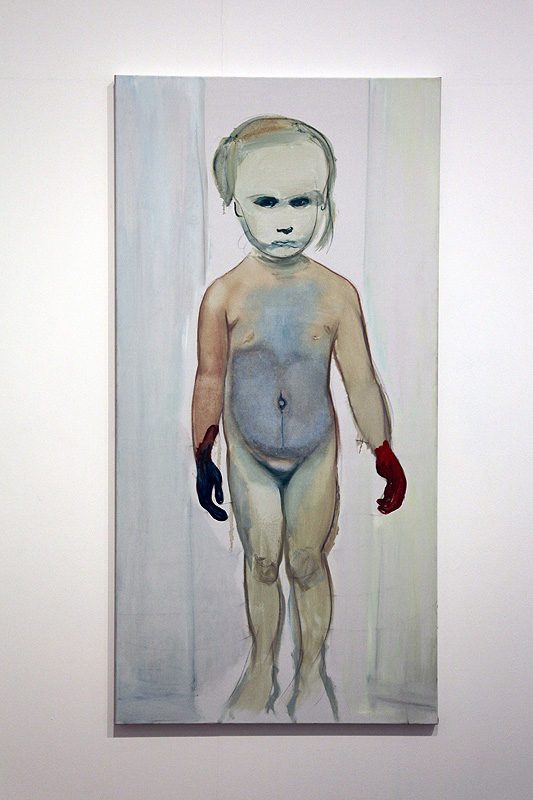
Marlene Dumas ‘The Painter’ (1984)
I was lucky enough to catch the Marlene Dumas retrospective The Image as Burden at Tate Modern last week. If I'd seen a show like this while I was still painting, I might never have given it up. Her work proves that contemporary painting can be socially and politically charged as well as deeply personal, beautiful and emotional.

Until Sunday 10 May 2015, Tate Modern, Bankside  http://www.tate.org.uk/whats-on/tate-modern/exhibition/marlene-dumas-image-burden

Thursday, 9 April 2015

Motion capture

Still from Asphyxia by Maria Takeuchi and Frederico Phillips
Glimpsed this at the end of BBC's Newsnight on 11 March and had to track it down. It looks as if it reveals the underpinning of super-real animation, but it may be more contrived than that. Nonetheless, it's amazing - and I'd love to see a bird version.  Text by Christopher Jobson.

"Asphyxia is an experimental film project by Maria Takeuchi and Frederico Phillips that explores human movement through motion capture technology. The team used two inexpensive Xbox One Kinect sensors to capture the movements of dancer Shiho Tanaka and then rendered the data inside a near photo-realistic environment.  Takeuchi & Philips say:

Motion data was captured using inexpensive sensors and that data paved the way through an extensive number of steps. Once all the scanned point cloud data was combined, that was then used as the base for the creative development on the piece. A series of iterative studies on styles followed and several techniques and dynamic simulations were then applied using a number 3D tools for various results."

Found at: http://www.thisiscolossal.com/2015/03/asphyxia-a-striking-fusion-of-dance-and-motion-capture-technology

See the full film at http://www.asphyxia-project.com/


Monday, 6 April 2015

Illegitimate Objects

Whiteboard in the office of Professor Sam Howison, University of Oxford Mathematical Institute
'The models were not 'evidence' in any sense of the term. They were boundary objects, good for trading meanings and for showing figures but illegitimate as objects of pure mathematics....'

Continuing my interest in geometry and abstraction, I've started on work for a forthcoming exhibition at the University of Oxford Mathematical Institute. Called Illegitimate Objects, it runs from 18 September to 12 November 2015. Invited artists are working with objects from the Institute's collection of geometric surfaces: precise plaster models, which date back to the late 19th century.

Featuring work by: Katrina Blannin, Simon Callery, Bella Easton, Tim Ellis, Gabrielle Hoad, Sally Howkins, Diane Jones-Parry, Elaine Le Corre, Stephen Lee, Iavor Lubomirov, Ruth Millar, Annabel Ralphs, Luke Ralphs, Felicity Shillingford, Kate Terry.

Mathematical Institute, University of Oxford, Andrew Wiles Building, Radcliffe Observatory Quarter, Woodstock Road, Oxford OX2 6GG  https://www.maths.ox.ac.uk/

Tuesday, 17 March 2015

Flights on paper

I've written an article about my work visualising bird flights using 3D printing, which has been published in a special Arts & Ecology issue of Digital Creativity (26:1). It tracks the processes I undertook and looks at what I learned from my attempt to make a seamless transition from action to data to object.

It can be read free for a limited time through this link.
http://www.tandfonline.com/eprint/Tnpb5MIce57HmCdrtAd3/full

Saturday, 14 March 2015

A model future

Gabrielle Hoad | The Grid and the Mesh (detail) | 2015
My exhibition is now up and running at the Environment & Sustainability Institute in Cornwall. It concludes a year-long collaboration with Dr Jonathan Bennie under the ESI/RANE Creative Exchange Programme, during which we made a study of microclimates on a Devon farm with a view to growing bananas.

Attempting to grow a tropical fruit such as bananas outdoors in the UK demands a leap of faith and an act of imagination. The project has been focused on envisaging alternative versions of our everyday growing and eating practices. 

Foreign Soil, Environment & Sustainability Institute, University of Exeter Penryn Campus, Cornwall TR10 9FE 
11 March – 15 April 2015 Mon – Fri 9am – 5pm

Foreign Soil was supported by the ESI/RANE Creative Exchange Programme and developed in partnership with OrganicARTS and West Town Farm. Technical Consultant: Tim King

Monday, 9 March 2015

Caught red (and yellow and pink and blue) handed


Peter Osborne 'Rainbow Gate' Rougemont Gardens, Exeter. Photo: Matt Burrows
Exeter City Council has been caught in the act installing yet more dubious public 'art'. Costing between £16,000 and £25,000, this decorative metal gate appeared unannounced in a high-profile location in the city last week. It connects the city's prestigious 'cultural quarter' (including a recently refurbished library and award-winning museum) to an important city centre park. 

It was commissioned and installed without public consultation, with zero input from experts in the city's cultural organisations, and without any kind of competitive bid. At a time when local authority budgets are under extreme pressure, the community's tolerance for this kind of nonsense is wearing thin. On Facebook, Matt Burrows, Curator and Gallery Manager at nearby Exeter Phoenix calls it "a horrible, retrogressive piece of bad design...the wrong thing, in the wrong place". He goes on to say: "The question is, at a time of dwindling resources for the arts, how this decision was taken and why [...] There seems to have been a breakdown in consultation, communication and aesthetic decision-making."

Councillors claim to be embarassed and upset by the ensuing media fuss. Yet they've been intent on blaming those who noticed rather than those who were involved in the dubious and far from transparent decisions that led to the gate's appearance. They claim it was commissioned two years ago, but that's hardly an excuse. They tried a similar trick back in 2008 with the hugely unpopular 'Voices of Heavitree' which was made by a team including the same artist-blacksmith Peter Osborne. At that time, Paul Osborne (any relation?), Environmental Improvements Officer at Exeter City Council, was left in no doubt about how the public felt.

Spending on the arts is quite rightly a sensitive issue in the current economic climate. Which is even more reason to use what we have wisely and well. As Matt Burrows says: "This city has a wealth of fantastic arts organisations, staffed by experienced arts professionals who are trained (and funded) specifically to deliver excellent, high quality creative projects." They're also used to squeezing exceptional value from every penny.  £16,000 - £25,000 would have gone a long way in their hands. Like many, I'm gutted and angry at the waste. And deeply concerned about the negative public reaction to arts spending that might result.

Tuesday, 3 March 2015

Imaginary landscapes (with bananas)


Gabrielle Hoad | Banana squared | 2015
I have a new exhibition opening in Cornwall on 11 March.  It comes at the end of a year-long collaboration with Dr Jonathan Bennie, an Associate Research Fellow at Exeter University's Environment & Sustainability Institute. It's part of Foreign Soil,
my documented attempt to grow edible dessert bananas outdoors in the UK. Although it provides an opportunity to reflect on our work together, the exhibition acts as a point of focus rather than resolution.

Centred on a pilot growing site, a south-facing pasture at West Town Farm near Exeter, we've mapped and modelled biologically relevant microclimates to make an informed assessment of the feasibility of banana cultivation – now or in a future climate scenario. Ways of enhancing the heat and humidity of microclimates through physical manipulation of the growing site have also been considered.

The work I’ve made for this exhibition looks at the notion of the model, both as a representation of something that might be built in the future (such as an architect’s model or an artist’s maquette) and as a simplified description that assists with predictions (such as computerised climate models). 
  
Foreign Soil exhibition - ESI Creative Studio 
Open 11 March – 15 April 2015
Monday to Friday  9:00am to 5:00pm

Foreign Soil seminar - ESI Trevithick Room 
11 March 2015  1:00pm – 2:00pm
We discuss our collaboration. Free. All welcome.

University of Exeter, Penryn, Cornwall TR10 9FE   

Foreign Soil was supported by the ESI/RANE Creative Exchange Programme and developed in partnership with OrganicARTS and West Town Farm.

Blog Archive

Followers