
 |
| Gabrielle Hoad Five pigeons, 74 seconds (2014) Photo: Jamie Morrison |
Saturday, 29 March 2014
Documentation I

Documentation II
 |
| Gabrielle Hoad Interloper (2014) Installation view. Photo: Kevin Burrell |
Thursday, 27 March 2014
Listening to Oxford
 |
| Hannah Rickards To enable me to fix my attention ... Installation at Modern Art Oxford (2014) |
However, I was really there to see Hannah Rickards' To enable me to fix my attention on any one of these symbols I was to imagine that I was looking at the colours as I might see them on a moving picture screen (15 February - 21 April). Exploring extraordinary natural phenomena (thunder, the aurora borealis, mirages), the work consists of attempts to describe the indescribable. Rickards deconstructs, then reconstructs and transcribes these phenomena through text, light, sound, colour, first-person accounts and re-enactments. At first pass, it's a very restrained and minimalist show, but one that richly rewards proper investment of time and attention. I didn't want to leave.
A friend recommended the Audiograft Festival (12 March - 28 March at Oxford Brookes University and other city locations), which included Gordon Monahan's A Very Large Vinyl LP Constructed in Acoustic Space in The Glass Tank. You sit (alone and very conspicuously) in the centre of eight loudspeakers, where you hear a collage of surface scratches and vintage easy listening records, spinning to create the illusion that you're the hole in the middle of a virtual vinyl LP.
Even better was Christina Kubisch's Electrical Walk. It's a self-guided walk around the Oxford Brookes campus wearing special, sensitive wireless headphones which make the acoustic qualities of above-ground and underground electromagnetic fields audible. From lift control panels to vending machines and cashpoints, every electrical item has its own unique electromagnetic signature. Slightly ominous, but nonetheless a whole new way to experience the everyday.
Looking at other people's work is never easy when you've been obsessing about your own during an exhibition install, so it was a lucky coincidence to be able to spend so much time listening instead.
Oddly enough, the listening theme continued back in Exeter when I went to see an artist's talk by Marie Toseland. Rather than talk through a series of images, she played her own Desert Island Discs, as well as video clips of rapping and beatboxing. All preparation for a new 'experimental opera' she's starting work on.
Wednesday, 26 March 2014
AA2A interim exhibition - Plymouth University
 |
| Kayleigh Hill The Balaclava Experiment PILOT AA2A show (2014) |
24 March - 16 April 2014 (by appointment only after 28 March, due to university holidays).
Exhibition of work in progress by the five artists resident at Plymouth University for the academic year 2013-14 as part of the national AA2A (Artists Access to Art Colleges) scheme: Tabatha Andrews, Sally Hall, Kayleigh Hill, Gabrielle Hoad, Lee McDonald.
Features my work in progress The being beyond. A model representing 74 seconds in the flight of five flocking pigeons is shown alongside a digital reproduction of Pigeon En Vol (1891-92)
by Etienne-Jules Marey and Georges Demenÿ, an early attempt to
understand bird flight through the application of recording technology. Bird flight data provided by Dr Steven Portugal of the Royal Veterinary College, London.
Tuesday, 25 March 2014
'Breaking of tulips' - Oxford Botanic Garden
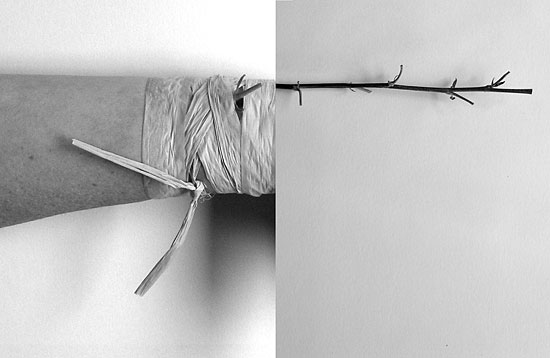
http://gabriellehoad.co.uk/interloper.php
Monday, 3 March 2014
Southwest shows catch-up
 |
| Installing Peter Randall-Page - Photo: Plymouth City Museum & Art Gallery |
Running around over the past few days to catch up with a number of South West exhibitions before they close later this month.
The Jerwood Drawing Prize 2013 is currently visiting Plymouth College of Art and Plymouth Arts Centre. As in previous years, the show has quite a focus on technical virtuosity, but this time many more of the most beautifully executed drawings also had something to say. I'm particularly haunted by Roy Eastland's gentle and meticulous homage (in delicate silverpoint on gesso) to the victims of the The Great Folkestone Air Raid of May 1917: “They looked like silver birds. The sun was shining on them...” In Plymouth until 9 March 2014, then at the Sidney Cooper Gallery, Canterbury Christ Church University.
Dartmoor-based sculptor Peter Randall-Page has his first major exhibition in the Southwest for 25 years, showing at Peninsula Arts at Plymouth University and Plymouth City Museum and Art Gallery. Inspired by the mathematical structures underlying nature, the work consists of a number of heavyweight sculptures in marble and stone alongside more modest (and much more likeable) works on paper. Through pouring, dripping and blotting, the artist has coaxed his ink into symmetrical branching structures that recall the veins of leaves or the branches of evolutionary family trees. Until 29 March 2014.
Outrageous Fortune: Artists Remake the Tarot continues at Exeter Phoenix until 15 March 2014, showcasing works by 78 diverse artists that interpret the famous deck of cards. The story behind the show adds to its impact, so it's a pity more people didn't come to hear curator Andrew Hunt talk about it last Saturday. It's significant that this body of work, focused on prediction and fortune-telling, was commissioned in 2008 at the start of the world economic crisis. Also that its evolution involves a complex and mischevious network of gifts and exchanges.
Steven Paige's A Treatise on Beasts (after Physiologus) continues at the Forum, University of Exeter until 25 March. Featuring both new works and items drawn from personal and historic archives, it presents a collection of beasts - both ancient and modern.
The work was developed during a residency with Exeter's Double Elephant Print Workshop as a response to the Ted Hughes and Leonard Baskin archive, held in the University of Exeter Special Collections.
Sunday, 2 March 2014
B is for bananas, birds, bud-grafting and busy
Lots of projects coming to a head right now. My work Interloper for 'The breaking of tulips' at Oxford Botanic Garden has just gone off to the printers, ready for installation in the third week of March. It's about bud-grafting - a subject drawn at random for me by the curators from back-copies of The Gardeners Chronicle. (Opens 22 March and runs until 26 May 2014).
Immediately afterwards, I'm doing a small show at Plymouth University's Room 101 with my fellow artists on the Artists Access to Art College scheme. I'm hoping to show two 3D prints of bird flights (part of the Solid Air project), which should be going into production this week. The AA2A show runs 24 to 28 March 2014.
My long-term art and ecology project Foreign Soil continues, boosted by support from the ESI/RANE Creative Exchange Programme. We're expecting delivery of our first (baby) banana plants next week and will be visiting a local farm to look at microclimates where they might be grown outdoors the week after.
Immediately afterwards, I'm doing a small show at Plymouth University's Room 101 with my fellow artists on the Artists Access to Art College scheme. I'm hoping to show two 3D prints of bird flights (part of the Solid Air project), which should be going into production this week. The AA2A show runs 24 to 28 March 2014.
My long-term art and ecology project Foreign Soil continues, boosted by support from the ESI/RANE Creative Exchange Programme. We're expecting delivery of our first (baby) banana plants next week and will be visiting a local farm to look at microclimates where they might be grown outdoors the week after.
Creative exchanges between art and science
I'm delighted to announce that I've joined the ESI/RANE Creative Exchange Programme as a Creative Affiliate. ESI/RANE is the research group of the University of
Exeter's Environment & Sustainability Institute and Falmouth
University's Research in Art, Nature and the Environment.
I'm going to be working with Dr Jonathan Bennie, ESI Associate Research Fellow, to further develop my project Foreign Soil.
The collaboration, which runs until January 2015, will model and
map biologically relevant microclimates in order to support a more
informed investigation of the feasibility of banana
cultivation – now or in a future climate scenario. As well as opening up conversations about climate change and food security, we hope this work will offer insights into ways of visualising and communicating complex spatial and temporal patterns of microclimate within landscapes.
Subscribe to:
Posts (Atom)