Monday, 12 December 2016

The critical and the creative

Frank Auerbach - Sketch: Mornington Crescent (1972)
The South West's perennial problem of how to generate more critical dialogue around the visual arts was addressed once again with the launch of the Art Writers Group at Hestercombe House last week. Originating in a writing workshop organised by Visual Arts South West, the group is co-ordinated by Peter Stiles and Josephine Lanyon and has just appointed four funded writers-in-residence at three locations: Plymouth, Cornwall and Bristol.

We heard from the writers in residence Patrick Langley (Cornwall), Lizzie Lloyd (Plymouth), Tom Jeffreys (Plymouth), and Mary Paterson (Bristol) as well as Phil Owen of Tertulia and Greg Neale of Resurgence magazine.

Topics under discussion included Authorship, Context and Publication. A highlight for me was Mary Paterson performing a text that took in, among other things, the refugee crisis, Vikings, walking and the slipperiness of memory.  I also enjoyed Lizzie Lloyd's conjuring of a painting by Peter Doig purely through words (and a little rhythmic pacing). Plus I got to spend a few precious minutes with a Frank Auerbach sketch in the gallery upstairs.

It was an inspiring day - and an opener to what I hope will be a far wider and deeper discussion, but the emphasis on creative writing in response to contemporary art side-stepped some of the more pressing issues surrounding art writing in relation to the region's art practice. I'm all for opening up the question of what critical writing might be but, to function in support of the visual arts ecology, it needs to be more than yet another creative activity.

The issue for me is that we need more critical dialogue around art. That means people who are prepared to respond rigorously to work in ways that allow its makers, curators and audiences to understand, learn and grow. I'm not arguing for critics as the ultimate arbiters of taste and quality, but about capable writers and speakers deploying integrity and precision in describing their responses.

I'm not saying this can't be done through creative writing, but riffing off of someone else's work to make a text work of your own is not always the same as trying honestly to interpret, and enhance appreciation of, that work. There's a reason why we might prefer to practice slightly oblique creative writing over reviewing - and that's because it's easier to hide what you really think. South West practitioners operate in a very messy, close-knit world where everyone has multiple roles. A writer might also be an artist who in 18 months time will be looking to collaborate with the artists or curators they're about to review.

There are other issues too. Although the subject of money was avoided until the closing minutes at Hestercombe, it is at the heart of how we create a properly critical atmosphere. If you want professional writers, curators, academics and critics to write generously and fairly about art, you need to pay them (or they will be too busy doing their actual jobs to give the art the time and thought it deserves). As paid opportunities for critical writing continue to shrink, it is increasingly the artists and arts organisations themselves who commission texts. Of course this need not actually stifle critical thinking, but we need to be alert to the fact that whoever pays the bill holds the power.

I have written on related topics before, back in 2014 and 2010. See more here:
http://gabriellehoad.blogspot.co.uk/2014/12/critical-friends-hard-to-find-harder.html
http://gabriellehoad.blogspot.co.uk/2010/11/good-and-bad-art.html
http://gabriellehoad.blogspot.co.uk/2010/09/is-there-right-way-to-write-about-art.html 

Sunday, 11 December 2016

Digbeth First Friday

Artists Behind Bars at Grand Union, Digbeth, 2 December 2016
What sort of landscape do artists in other cities operate in? How do they solve problems like money, space, resources, profile-building, critical dialogue and networking? Can productive connections (both real and conceptual) be made between their environment and the community in which I work?

I was lucky enough to join Preston Street Union's December trip to Digbeth First Friday, a co-ordinated monthly opening of Birmingham visual arts venues. Over seven intense hours we toured this thriving industrial area on the edge of the city centre, getting a flavour of Birmingham's artist-led activity. We also reconnected with PSU's founder Trevor Pitt and other artists such as Juneau Projects and Cathy Wade who were involved in our early days with Spacex. 

First stop was the Daphne Francis Gallery in the landmark Custard Factory where we met the Cobalt Blue artist group and viewed their show Balance. From there we went on to the Eastside Projects Winter Art Fair, where we also saw Simon Bayliss' show Frantic Romantic and glimpsed elements of The Production Show with works by Linda Brothwell, Alice Channer, Nicolas Deshayes, Des Hughes and Peter Nencini. 

At Grand Union we visited shows at Vivid Projects: Black Hole Club and Centrala, then stopped for food at Digbeth Dining Club - a weekend street-food market.  Next up: A3, a space run by Trevor Pitt and Oliver C Jones, to see Catching Rabbits & Starting Fires, an event by Tom James focused on survival skills. We caught up with Juneau Projects, who we'll be working with next year, and met Mark Murphy who has a show of collage works - Remains - in the A3 project space with John Bennett. 

Back at Grand Union, we ended the evening at the Artists Behind Bars Christmas party with Fierce, where invited artists ran themed bars within a warehouse party setting. It made me think of the recent talk in Exeter by Marvin Gaye Chetwynd and her belief that enabling other people to play is a legitimate way to make art.

The quality and quantity of affordable space for art and artists close to city centre is a key factor in the success of the Birmingham visual arts scene. But its extraordinary level of ambition and energy is also driven by a strong local art school, a young and diverse population, and a high volume of resident artists. Exeter will never match it, but that doesn't mean we can't learn from it.

Thursday, 17 November 2016

A singing bit of blue

Calver David Hoad | Throw only to an alert catcher | 2016 | Gallery 333
Following on from its first showing in some beach huts at Dawlish Warren, the work I made with Megan Calver and Susie David is having a second, smaller outing at Gallery 333, Exeter Phoenix.

Given the space restrictions, it's very much an edit of the work we showed before, but with the addition of some more objects from our fieldwork and a rather special blue. This colour harks back to early spring when we gazed up at the sky, trying to spot the larks we could hear so clearly.

We wanted to bring a sense of the outdoors into the gallery, so we used a colour matched to the hue of the deepest blue in a photograph of a clear Dawlish sky. It's a translation that works for me, given that the idea of mimicry (and inevitable slippage between signs and things) pervades our collaborative work.

http://www.exeterphoenix.org.uk/events/throw-only-to-an-alert-catcher/

16 November 2016 - 7 January 2017
Exeter Phoenix, Bradninch Place, Gandy Street, Exeter, EX4 3LS

Thursday, 10 November 2016

Throwing again to alert catchers

Following on from our two-day show in October in some beach huts, the work I made with Megan Calver and Susie David at Dawlish Warren National Nature Reserve is having a second, smaller outing at Gallery 333, Exeter Phoenix.

We're using this intimate installation space to show our video reel and a selection of objects from our fieldwork. Our joint actions and activities focused on creating dialogue between the human and nonhuman, often through strategies such as mimicry and hiding.

http://www.exeterphoenix.org.uk/events/throw-only-to-an-alert-catcher/

16 November 2016 - 7 January 2017
Mondays to Saturdays 10am-5.30pm (Please check opening times if visiting over the Christmas period.)
Exeter Phoenix, Bradninch Place, Gandy Street, Exeter, EX4 3LS

Wednesday, 26 October 2016

Fieldwork (once more, with feeling)

Calver David Hoad | lie lie lie | 2016
I’ve just completed a show of work in progress with fellow artists Megan Calver and Susie David. Throw only to an alert catcher was held across three beach huts on the site where we've been working together for the past six months - Dawlish Warren. We showed a series of videos, made a small dark-space installation and shared various objects and traces gathered during our time on site. We also produced a small artists’ publication. It's the culmination of our a-n supported project The Buffer Zone.

Having spent all this time in an intense collaboration with other artists and a site, and thinking/talking as ‘us’ and ‘we’, I’d rather let go of where this work fits into my existing practice. It took a student visitor to the show, who was aware of my previous collaborations with scientists, to ask the question about how it all fits together.

What I brought to this latest collaboration was a desire to work with the idea of the hide. Used by naturalists, film-makers, hunters and soldiers, the hide is a camouflaged structure which seeks to efface the presence of the human observer and encourage 'natural' behaviour in those observed. Hiding was an extension of my previous interest in surveillance, but an approach I hoped would put me back out in the landscape rather than keeping me behind a computer.

Now, through working collaboratively with artists rather than scientists, I've switched from traditional scientific fieldwork to what I and my colleagues have termed ‘poetic fieldwork'. It's quite a change. At one point during Foreign Soil, I was regularly collecting temperature data from field instruments that was used as material for my own work but also as input to verify climate models. These days I still go out into the field armed with various instruments (or prosthetics) and attempt to make observations and discoveries, but it's far more open-ended and intuitive. It’s an attempt to build understanding of the site's nonhuman inhabitants on their own terms.

This playful, spontaneous and slightly ‘magical’ approach is a real contrast to my previous focus on testing the limits of objectivity and rationality – and one I actively sought. We've fostered dialogue, both between ourselves, and with the site and its inhabitants – and been acutely aware of how each affects the other.

Many themes have emerged from our work – of entanglement, liminality, slippage of language, the ‘life’ of ‘inert’ objects but, for me, one of the most resonant has been the idea of lying to get closer to the nonhuman. This is lying in multiple senses: of deceiving (pretending to be what one is not, perhaps through mimicry), of getting physically closer to the earth, and of hiding (by becoming prone) to make observations. And we are not the only ones who do it: lying is a strategy we've observed throughout our time at Dawlish Warren, from man-made objects pretending to be 'natural' objects to a log-like seal basking largely unobserved on a beach.

Tuesday, 25 October 2016

South West Autumn art blitz


Plymouth Art Weekender: Intercity 16

Crammed in so much art of late, I can do little more than list it.

B-SIDE
Went to the fabulous b-side festival on the Isle of Portland in Dorset on 16th September as part of an artist development day – The Crucible, which was co-organised by OSR Projects  and Six Projects. The b-side team laid on a bus and we had a whirlwind tour of some of the sites on Portland. Highlights for me included The Sonic Anomaly Sideshow by Lee Berwick at the Verne High Battery, Elaine Fisher’s Para(meter) at The Weather Station (lovely use of long-playing records to evoke geology/walking/distance) and Unseen and Unheard Things by Debbie Adele Cooper at St George’s Church (a perfect meeting of site and subject, even though the work, on conscientious objectors, originated at Dartmoor Prison). We spent the late afternoon in wide-ranging discussions on everything from audience engagement to networking, and finished up with a communal dinner at the Drill Hall.

PLYMOUTH ART WEEKENDER 
Another multi-site festival of visual art, Plymouth Art Weekender took place over 23rd, 24th and 25th September. I visited eight amazing shows in one day, but highlights were BimBam in Selbst by architects/sculptors Winter and Hoerbelt at KARST, Low Profile’s Impromptu at the Athenaeum, the ever-inventive Phil Magee at HQ and the tiny living room show of Holly Knowles with his amazing algorithmic drawings. A recent graduate of Plymouth University, his work goes from strength to strength.

EXETER PHOENIX
Back home in Exeter, Beth Emily Richards staged a performance lecture to accompany her Gallery 333 installation, called No such event took place.  A re-enactment of documentary material from the supposed visit of Michael Jackson to Exeter City Football Ground in 2002, it was unexpected and very entertaining. Later in the month, an artists' moving image screening to accompany the Exeter Contemporary Open included work by Anne-Marie Creamer,  Nick Jordan, Naomi Frears and
Dorine van Meel alongside a manic, brutal and extraordinary film by Thomas Yeomans that left me reeling for days afterwards.

MARVIN GAYE CHETWYND 
Finally, a wonderful talk by Marvin Gaye Chetwynd at Exeter School of Art. Like many people I struggle a little with her work, but understanding the sense of fun that drives it, and hearing from the warm and engaging woman behind it, took me a step closer to appreciating the reasons for her critical acclaim.

Thursday, 29 September 2016

Throw only to an alert catcher

Calver David Hoad | Throw only to an alert catcher | 2016
I'm pleased to announce that I'll be showing work in progress arising from a collaboration with Megan Calver and Susie David at Dawlish Warren National Nature Reserve.

THROW ONLY TO AN ALERT CATCHER
Red, blue and yellow beach huts, Promenade, Dawlish Warren EX7 0NF
Friday 21st and Saturday 22nd October 2016
11am to 5pm

Supported by a professional development bursary from a-n The Artist Information Company.

Directions and further details.

Thursday, 30 June 2016

Open Aviary - 15th July to 30th August

Gabrielle Hoad | Three pigeons, 127 seconds | 2014 |  Laser sintered nylon 
Two of my bird-flight sculptures will be appearing in 'Open Aviary' on the Isle of Sheppey in Kent: Friday 15th July - Tuesday 30 August 2016.

Taking place during the Sheppey Promenade Festival 2016, this exhibition celebrates the island’s strong connection to the idea of flight, both through aviation and avian flight.

Julie Bradshaw | Gen Doy | Lynn Dennison | Anna Bridges | Anne Ho Cooper | Karen Crosby | Paul Crocker | Laurie Harpum | Gabrielle Hoad Amanda Hopkins | Beth Lannings |Victoria McBride | Linda Newcombe Michaela Nettell | Nicole Mollett | Susan Petticrew |Deborah Pugh | Jane Oldfield | Mark Sosbe | Hugh Ribbons | John Gevais-Ross

The exhibition takes place across two venues: Rose St Cottage of Curiosities and Room at Sheerness Dockyard Church, Garrison Road, Blue Town, Sheerness ME12 1RR.

Visit the website for opening hours

Wednesday, 1 June 2016

An experiment is not a rehearsal

I was unprepared for making work on a recent trip to Portland, Dorset*, so found myself improvising. I used an old and basic camera to record a snatch of video, but forgot it didn't automatically record audio. So although I have a long and mysterious shot of one of the empty tunnels at the Verne High Angle Battery, I didn't manage to record the startling expletive my colleague shouted down it towards me from the opposite end. She was reading graffiti from the walls outside.

Never mind, we said, we can always come back and do it another day. But it won't have the same sense of eerie anticipation and certainly not the shock value. I won't be waiting and wondering where she is and what she'll say, while feeling slightly spooked by the semi-derelict site around me. You might think the footage would look the same, even if I don't feel the same as I record it - but it won't.

After working together on a series of spontaneous actions, we're discovering that you need to keep the camera rolling (and make sure it's working properly too). You can't treat experiments like rehearsals for the real thing. More often than not the real thing only happens once, when you least expect it, and usually with some inconvenient wind noise or the sound of a passing train in the mix. So maybe on this occasion, the silence says it all.

*I was there with fellow artists Megan Calver and Susie David to learn more about the amazing bi-annual b-side festival and the team behind it, of which more on another day.

Tuesday, 31 May 2016

Plymouth latest

Vanessa Billy | 'End of Days' |  2013 | Vase, mud, water and used light bulbs
As Exeter watches its art infrastructure wither, Plymouth's galleries are thriving. Last Thursday was an excellent crossover point between five outstanding shows.

Conversations Across Art and Mathematics at Peninsula Arts (9-28 May) was of particular interest to me after my work last year with the Oxford Mathematical Institute. Devised and curated by Barry Phipps, it included work by painter Mark Francis and architect George L. Legendre, alongside a film by Plymouth artist Heidi Morstang. A highlight for me was a wall-size print-out of Legendre's book Pasta by Design and I also enjoyed eavesdropping on mathematicians' thinking processes via Mortstang's film. But I was definitely left on the outside looking in.

good things come... at The Gallery at Plymouth College of Art (25 April - 4 June) curated by Kevin Hunt and Hannah Jones featured (mostly) small works by Agnes Calf, Alex Frost, Clive Murphy, Eric Bainbridge, Hayley Tompkins, Jack Lavender, Jo Addison, Kevin Hunt, Leo Fitzmaurice, Oliver Tirre, Peter Amoore, Richard Wentworth, Ryan Gander, Ruth Proctor, Sean Edwards, Susan Collis and Vanessa Billy.  I found this collection of work very exciting, but couldn't quite get a handle on the underlying concept: that the size of an object and our attention upon it might be intrinsically linked to time.  Sadly I had to skip the companion show at KARST F*** Newton (28 April to 28 May).

Quick look in on on Holly Davey's Here Is Where We Came From at Plymouth City Museum & Art Gallery (7 May - 3 September) then on to Kelly Best's All Walls Are Interrupted at Plymouth Arts Centre (15 April - 11 June). I was particularly taken with a site-responsive wall drawing based on the building's slate roof (more geometry). It gave me a way back in to Best's paintings, which I've previously found hard to figure.

Sunday, 22 May 2016

A sense of #AWE

Jimmy Cauty | Aftermath Dislocation Principle | 2016
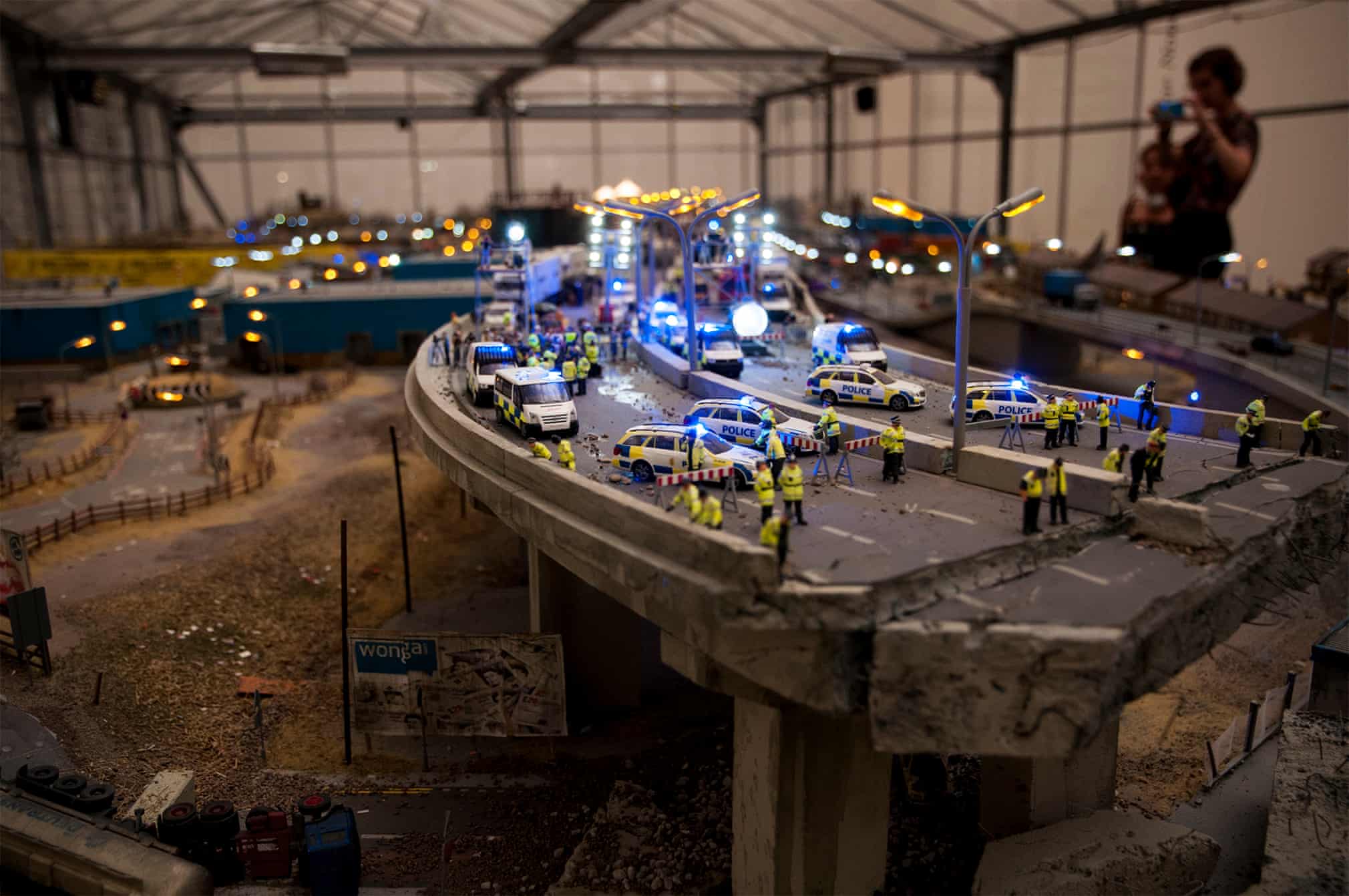
The inaugural Art Week Exeter (AWE), which ran from 9 to 15 May, brought together existing contemporary art events (such as the Sean Lynch show jointly presented by Spacex, Exeter Phoenix and RAMM) with the annual Exeter Open Studios event and its low-profile shadow NOSE. Possibly one of the most successful collaborative arts ventures the city has seen, it was coordinated not by the council or by any of the city's established arts organisations, but by independent artist and curator Stuart Crewes.

I managed to check out Jimmy Cauty's Aftermath Dislocation Principle, Sean Lynch's The Weight of the the World, Lousie Ashcroft's Discrete Infinity, the Museum of Contemporary Commodities' pop-up shop and talk at TOPOS, Konstantin Bayer's art-articles, US CHAPS - a collaboration between Cannon Hill Art School and Preston Street Union and Naomi Hart's Drawn to the North.  I would have liked to do more, but time was short and the listings long (101 events across 56 venues).

The inevitable issue with new arts events in small cities is that the main audience are also the main providers of the event. So everyone's too busy doing their bit to go see anyone else's. But it was a great test-run - drawing together the diverse strands of Exeter's visual arts community in one well coordinated, well marketed and (in certain hot-spots) well attended festival, which could credibly be promoted to a far wider catchment in future years. It made me feel hugely optimistic about the outlook for visual art in Exeter.

Monday, 16 May 2016

Feed (2016)

Gabrielle Hoad | Feed | 2016 | Hand-punched bookmarks, secreted in library books
Feed considers the library as a source of information but also as a habitat where a variety of different species might thrive. Common library visitors coded onto bookmarks include Liposcelis bostrychophila (booklouse), Lepisma saccharina (silverfish), Lasioderma serricorne (cigarette beetle), Tineola bisselliella (clothes moth), Mus musculus (house mouse) and Eurotium rubrum (foxing mould).

First made for Preston Street Union's intervention in Exeter Library during Art Week Exeter in May 2016.

Monday, 9 May 2016

Graft (2016)

Gabrielle Hoad | Graft | 2016 | Digital print transfer, paint and Perspex
Images from a 2014 work Interloper were remade as Perspex 'postcards' for a project on the theme of trade/exchange. They contain images of imagined human/plant grafts set in the context of Robert Sharrock's famous 1660 account of plant grafting methods. Graft was made for an exchange of small-scale work between Preston Street Union in Exeter and Cannon Hill Art School in Birmingham

A first showing of outputs from this project was made in a disused shop as part of Art Week Exeter: 10-15 May 2016.

Wednesday, 4 May 2016

Uncertain territory

The Buffer Zone | 2016 | Photo: Susie David
Latest a-n blog post on my collaborative project with Megan Calver and Susie David, The Buffer Zone, which is supported by a bursary from a-n The Artist Information Company.
https://www.a-n.co.uk/blogs/the-buffer-zone/post/52448309/

Tuesday, 5 April 2016

Hide #4 (Lie)

Hide #4 (Lie) | 2016 | Photo: Susie David
I've recently spent two days working with Megan Calver and Susie David at Dawlish Warren Nature Reserve as part of our collaborative project The Buffer Zone. It's a chance to challenge each other, to explore joint working, and to look at areas where our individual practices intersect.

I'm continuing to work with the idea of the hide as part of this project, which includes seeking opportunities to blend into the landscape. Such actions align with themes of mimicry that cut across all of our practices, as well as being part of a shared inquiry into the possibilities of live experimentation.

Monday, 4 April 2016

EX has lost its SPACE

Spacex at Preston Street, Exeter
At 7pm on Saturday 2nd April, Spacex closed its doors at Preston Street, said goodbye to its role as a permanent gallery space and began a new future as a commissioning organisation. From now on, rather than running a rolling programme of gallery shows, it will collaborate on projects with different curators, spaces, organisations and artists.

Spacex was an internationally important contemporary art gallery that punched way above its weight in terms of the art and artists it attracted to the south west. It was one of the reasons I moved to Exeter and one of the reasons I've stayed. However, the removal of regular Arts Council funding a couple of years ago put it on a path where operating out of a permanent building was no longer viable.

The city will feel the loss of its only dedicated contemporary art space, just as it felt the loss of its art school. We are running out of public spaces that aren't devoted to shopping. I hope it's a creative shift that makes room for new ideas, new participation and new opportunities, but only time will tell.

Thursday, 17 March 2016

Placement and displacement

This photo gives a taste of what I've been up to this week with artist Charles Richardson, along with another member of Preston Street Union and two students from Exeter School of Art. We were helping Charles construct one of the works for his forthcoming show at Exeter Phoenix: Displacement Behaviour. Runs 18 March to 30 April 2016.

Wednesday, 16 March 2016

Poetic fieldwork at Dawlish Warren

Gabrielle Hoad | Hide #3 (Hand/Twigs) | 2016
I'm pleased to announce that I've been awarded an a-n Professional Development Bursary with Megan Calver and Susie David. This will allow us to undertake a self-organised residency at Dawlish Warren National Nature Reserve during 2016.

You can read the a-n announcement here.

Monday, 8 February 2016

Sticky fingers

One result of today's experimental photo making.

Saturday, 6 February 2016

Co-labour versus collaboration

  1. Collaboration:  1.  the action of working with someone to produce something. 2. traitorous cooperation with an occupying enemy.
Filing away some old emails, I felt a jolt of anger when I was reunited with an aggressive missive from a former collaborator. It wasn't unusual behaviour for him, but this particular communication (kept all these years in case of legal ramifications) had turned out to be the final straw for me. I made the decision to walk away from two years of hard work rather than risk my wellbeing and reputation any further. 

Since then I've had many, far happier, far less complicated collaborations with other artists. Messy, inefficient, awkward, frustrating, exhausting - yes, but all ultimately worthwhile. But I will admit I'm often wary (and even a tiny bit cynical) whenever I hear the words 'artists collaboration'.

You see, being part of a self-organised artist collaboration isn't like joining an established team or workplace. There's rarely a structure of responsibility, no established ways of behaving as a group, no etiquette, nowhere obvious to turn for mediation when things go wrong.

When permanent groups form, there are certain things you might expect to have to negotiate formally or informally: workloads (and how much each person has to take on), responsibility (who's accountable), and organisation (how much of it is necessary). But there's rarely much incentive to formalise these aspects when you're being as nimble as artists need to be. And so you stumble along, sometimes with positive results - but not always.

Meanwhile you learn more than you ever wanted to know about your collaborators' attitudes to trust, privacy, fairness, personal property, honesty, money, the law, the welfare of others. And your own will be exposed too. Of course, we all think our own attitudes are the normal ones. Which means collaborations can be very tense, especially if it's how you first get to know someone.

Working with existing friends can challenge friendships, but it also means fewer surprises, greater ease of communication, and a prior investment in a relationship that you don't want to lose. It also means you're a little more forgiving of each other's foibles.

But strangers can be successful collaborators too, as my recent involvement with the Preston Street Union proves. This loose collaboration, which grew out of artist Trevor Pitt's residency at Spacex in 2015, brought together a slightly random collection of around 20 local artists, and focused on the idea of "artists making things and making things happen". And that's exactly what we did for a few hours each week, over five weeks. Facilitated by visiting artists, we improvised short-term collaborations in small groups, making work with what was to hand (most often ourselves).

Previous collaborations have often meant grappling with long-term bureaucratic processes such as funding applications and project planning - usually during lengthy meetings. By contrast, these swift, spontaneous bursts of working with other artists opened up new and exciting avenues. Along with some genuinely thrilling moments, there were also times when the process led to little more than anxiety, paralysis and failure - but it didn't matter because each 'project' was quickly done and I always learned something. 

So if I have some guidelines for myself after all these years, they are these. Collaborate freely but keep collaborations short or at least time-defined. Move carefully: be generous with your time and energy but keep in step with others. The success of a collaboration is everyone's responsibility and you won't save one that's in trouble by powering ahead alone. Avoid bureaucracy wherever possible, but if you're doing anything that involves signing contracts, handling significant amounts of other people's money, or other people's property or safety, beware of collaborators who insist you don't need to organise. You do.

Thursday, 7 January 2016

Hide #2 (Exposure)

Gabrielle Hoad | Hide #2 (Exposure) | Digital photograph | 2016 
Building on my interest in animal surveillance and the way scientific knowledge is constructed, I have been working with the idea of the hide, a camouflaged structure that seeks to efface the presence of the human observer and encourage 'natural' behaviour in those observed. 

I'm interested in the hide as a means of surreptitiously entering the territory of another, but also in the alternative definition of hide as skin, a notional boundary between self and the world. This series of long-exposure photographs seeks to dissolve figure into ground.

Blog Archive

Followers