Tuesday, 17 December 2013

Hands-on 3D printing (in clay)


Icebergs - digital pots by Jonathan Keep (www.keep-art.co.uk)

I've discovered another hands-on way of practising digital printing, this time using a paste of extruded porcelain driven by compressed air. You mix the clay and fill the cartridges yourself, and spoon powdered clay around the form to support it as it's built. (An alternative is to dry it with a hairdryer to harden the structure as it forms.)

It's demonstrated here by ceramicist Jonathan Keep.

http://www.youtube.com/watch?v=VxNzo3ckVOo

The only problem from the point of view of my project is that the process is restricted to creating cylinders. The cylinder shape can be deformed in any way, but you need to design for a continuous extrusion of wet clay.

Thursday, 12 December 2013

Art as measurement

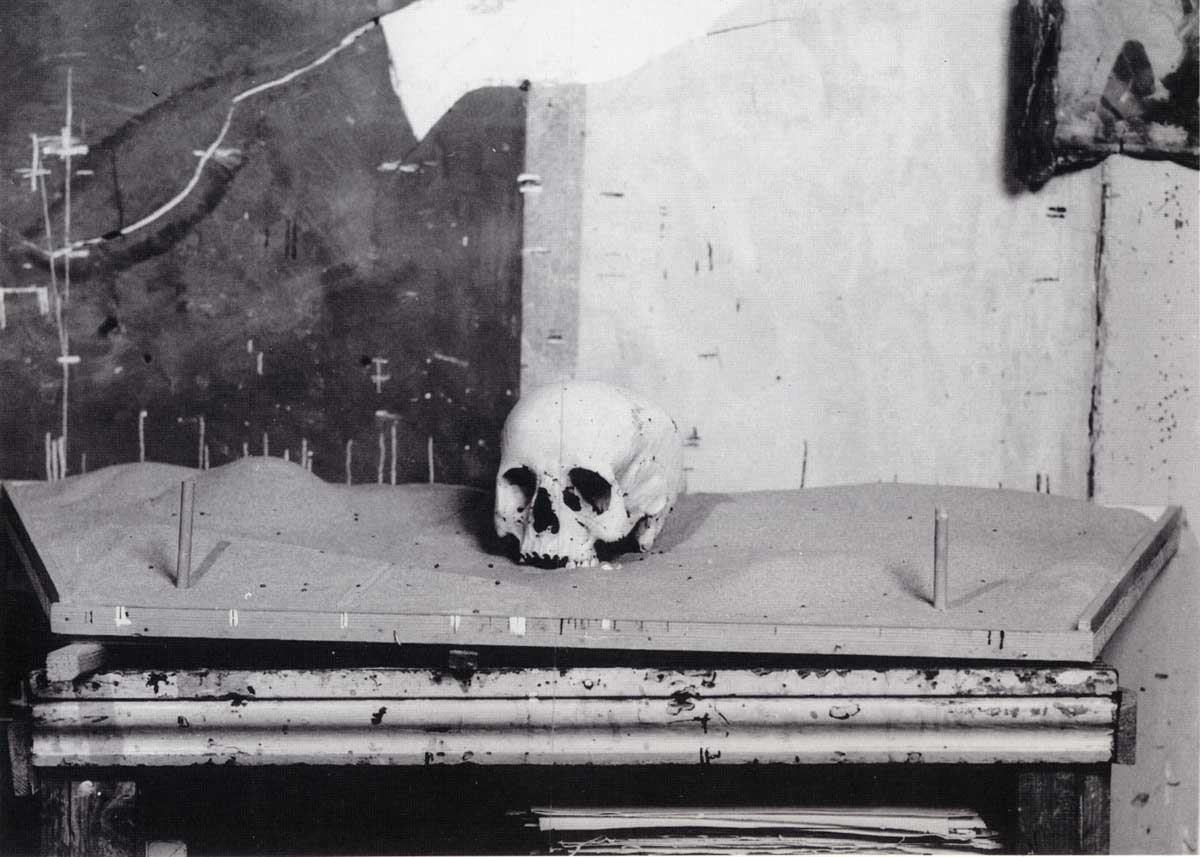
Euan Uglow - Studio set up for Skull 1994-7
Creating 3D digital models of flights means placing precise xyz co-ordinates in virtual space that refer back precisely to real space. Prompted by this process of transcription, but also by recent experiences at life class, I've been looking again at the paintings of Euan Uglow and his mentor William Coldstream. They searched for 'irrefutable data' in image-making and Coldsteam is even described as 'scanning' his subject in relation to a series of horizontal axes (Lampert 2007). Both artists constructed their set-ups using plumb lines and markings to make measurements which were then meticulously transferred to canvas.

There is some discussion of Uglow's process (with illustrations) by Neil Plotkin on the Painting Perceptions blog.

Lampert, C. (2007) Euan Uglow: The Complete Paintings  London: Yale University Press

Tuesday, 3 December 2013

Hand-crafted computing

'Failed' test print of flight data using MakerBot
My rather hands-off digital project Solid Air now seems to be getting more hands-on.

As part of my AA2A placement, I've been able to work with a technican at Plymouth University to create a test model with a MakerBot . (This is the DIY end of the 3D printing spectrum and forms models by layering a melted a plastic filament.) I used existing glider GPS so I could compare the results with high-end laser sintering. Technically it was a failure - too fragile and something of a misprint, but I was really pleased with the slightly messy 'spun sugar' effect, which showed me the data in a new light. It was also great to have another solid object in my hands.

Second, the manipulation of the flight data from a flock of pigeons is now moving along much faster. There have been a number of false starts, partly due to the sheer quantity of data but, with the help of a programmer, I'm now some way to having a simple interface that allows me to turn streams of numbers into quick digital sketches and look for interesting flight patterns. It's this ability to work directly with the data - coupled with the tailor-made programming - that's helping me feel much more like a maker working with other makers than a project manager.

Blog Archive

Followers