Monday, 15 December 2014

Mapping resources

Exeter visual art resources - 2014 (first draft)
The quick sketch above was prompted by a recent meeting of Exeter visual artists and arts organisations. Called by Exeter Cultural Partnership in collaboration with Visual Arts South West, it was a rare opportunity for this diverse group (which included everyone from self-confessed 'dabblers' to the acting director of Spacex, Nicola Hood) to meet. While there was some inevitable venting of pent-up frustrations, what began to emerge is just how rich this city is in resources, expertise and opportunity.  We currently have one of the highest levels of spending per head on culture of any city in the country. And, while that is likely to diminish, we start from a point of strength.

People talked a lot about what we've lost and what we lack, but I'm amazed, when I think about it, by what we have. I was also really heartened by the voices that called for artists to be confident and ambitious. Like them, I'm all for generating ideas and trusting that resources will follow.

Monday, 8 December 2014

Critical friends ─ hard to find, harder still to keep

A Kaleider lunchtime talk by theatre writer Belinda Dillon last Friday offered a new opportunity to consider the whys and hows of creating a critical culture within Exeter's arts community.

Having written about theatre for a number of years, Belinda has been working with Kaleider to reflect more deeply on the role of  'the critic' in the local arts ecology. For her, Theatre Bristol's Writers in Residence Scheme is something of a beacon as it invites a diverse range of people to respond to performance work, often in very creative ways. Curated/edited by two paid writers (Richard Aslan and Tom Wainwright), the focus is on positive and supportive interviews, interactions, reviews, comments. It also positions critical writing as an interesting creative practice in its own right.

In the discussion that followed, it was clear that theatre-makers are as keen for peer critique as visual artists, though some feel this is better offered in a 'safe' or confidential context than via publication. At the same time there's a hunger for official recognition from what are frequently referred to as 'star reviewers', but less enthusiasm for a blogger-type free-for-all. As someone pointed out, in live performance you don't need a critic to tell you if a performance worked for an audience: there's instant feedback in the form of laughter or applause.

A key issue is: if we want professional critics, who's going to pay them? Star reviewers don't pop up fully formed out of nowhere ─ someone has to train and develop them. That means sustained opportunities for writers to develop their skills and knowledge (not just occasional bursaries and short courses).

A common solution seems to be 'embedding', where writers are paid by an arts organisation ─ either directly or indirectly ─ to play the role of critic, commentator and sometimes mentor. This can work well, but can blunt the writer's critical faculties if the relationship gets too cosy. It can also result in 'critical writing' being used as a marketing tool. In other words, objectivity is compromised. Is a writer short of paid work really going to bite the hand that feeds? And what does that mean for honest debate and the quality control it promotes?

There was also talk of a 'shared community of interest' that dissolves the barriers between professional critics, peers and audience members. It's a great idea but it's likely to end up muddied by personal loyalties (or even hostilities).  Don't we also want to hear from independent observers, who can try to be at least a little bit objective?

I speak as an arts practitioner who has largely suspended her critical writing practice, partly because the trickle of money it once generated dried up completely, and partly because navigating the murky waters of marketing writing versus critical writing was getting way too complicated. And that's before you even consider the problem of building trust with fellow practitioners while keeping critical integrity intact...

I've written on this topic before, back in 2010. See more here:
http://gabriellehoad.blogspot.co.uk/2010/09/is-there-right-way-to-write-about-art.html 
http://gabriellehoad.blogspot.co.uk/2010/11/good-and-bad-art.html

Saturday, 6 December 2014

Columbarium

I'm showing a new work called Columbarium in Gallery 333, Exeter Phoenix from 12 January to 7 March  2015.  It's a mini-installation that draws on early cinematography and the latest 3D printing techniques to test the limits of objective knowledge.

Presented in the museum-like setting of Gallery 333's glass cabinet, the objects reference humankind's ongoing investigations of bird flight – through dissection, through the use of cameras and through the application of 21st century surveillance technology such as birdborne GPS.

Derived from the Roman word for a pigeon house, a columbarium is a compartmentalised structure for the storage of mortal remains.

Columbarium arises from an Arts Council funded research and development project 2013-14 to map and model bird flight. Bird flight data was provided by Dr Steven Portugal of the Royal Veterinary College, London. Frames showing bird flight are extracted from footage of Pigeon En Vol (1891-92) by EtienneJules Marey and Georges DemenĂ¿.

http://www.exeterphoenix.org.uk/events/gabrielle-hoad/

Friday, 3 October 2014

Lost


Lost (Two pigeons, 153 seconds) | 2014 | Digital print

Part of my research project, Solid Air, this image was made from data collected by two homing pigeons. They were carrying specialised data-loggers to track their altitude, longtitude and altitude five times per second. After release, they were supposed to follow the rest of the flock home to the Royal Veterinary College, but seem to have decided to take a detour.

During the 153 seconds depicted here, they flutter about a bit before making a characteristic orienting loop together. However, moments after they flew off in separate directions (both were later safely retrieved). I'm intrigued by the coincidence that, during its period of truancy, one of them ended up flying over a street where I lived many years ago.

Saturday, 20 September 2014

Taking flight

Three pigeons, 127 seconds | Laser sintered nylon 20 x 25 x 6cm
Three beautifully printed models arrived on Thursday. All part of Solid Air, my Arts Council funded project to capture bird flight using specialised data loggers and 3D printing. Take a bow Ogle Models and Prototypes of Letchworth. I've learnt the hard way that not all rapid prototyping companies take as much care as they do. 

Monday, 15 September 2014

Listen to Easterbrooks

Listen to Easterbrooks | 2014 | 50-minute sound sequence, looped, with digital imagery
I'm sharing some work in progress at Devon Open Studios.  Listen to Easterbrooks is an experimental transcription, in sound, of temperature data collected from Easterbrooks, a warm, south-facing pasture on West Town Farm, near Exeter. Five different sensors are represented by five different sampled sounds, which are played so that each semitone represents a difference of 0.5°C in temperature reading. Higher pitched sounds represent warmer temperatures, while lower pitched sounds correspond to cooler temperatures (usually at night). Readings were taken every 30 minutes over 40 days in July and August 2014, and each 24-hour cycle takes about 75 seconds to play as sound.

These measurements of soil and air temperatures were made as part of a collaboration with Dr Jonathan Bennie, an Associate Research Fellow at Exeter University’s Environment and Sustainability Institute. The project, Foreign Soil, asks what it means to eat local food, through a documented attempt to grow edible dessert bananas (Dwarf Cavendish) outdoors in Devon. 

It's on just for one week at OrganicArts, West Town Farm, Ide, nr Exeter, Devon EX2 9TG.  11am-6pm daily.  It's installed in a stable in the farmyard, but you can also listen on mobile devices in Easterbrooks itself.

Foreign Soil is supported by the ESI/RANE Creative Exchange Programme and OrganicArts. Technical Consultant: Tim King. 

Monday, 18 August 2014

Monday, 28 July 2014

AA2A show at Plymouth's Civic Centre

There's a final show by the artists who took part in the Artists Access to Art Colleges (AA2A) scheme at Plymouth University 2013-14: Tabatha Andrews, Sally Hall, Kayleigh Hill, Gabrielle Hoad and Lee McDonald, plus the three student reps who've supported us: Rachael Allain, Jamie Morrison and Luke Walder.

I'll be showing three working drawings from my digital visualisation/bird flight project 'Solid Air'. It takes place at the Plymouth City Council House, Civic Centre, Armada Way, Plymouth PL1 2AA. The exhibition is open to the general public every Friday in August (1st, 8th, 15th, 22nd and 29th) between 12.00 and 2.00pm. There will be a closing event 4.00pm-5.30pm on 29th August as part of the city-wide Open 4 multi-venue arts event organised by Visual Art Plymouth.

Part of Plymouth's Civic Centre Precinct, The Council House dates from 1954. Its post-war interior is of national significance and provides a fantastic backdrop for a rolling programme of exhibitions by contemporary artists with a connection to Plymouth. The programme is supported by Plymouth City Council.

You can find out more about The Council House exhibitions programme here:
http://councilhouseart.wordpress.com/about/


Sunday, 29 June 2014

Foreign Soil Field Trip


"Throw a hoop to pick a random patch of ground. Log, describe and count everything you find there." Field Trip - 29/06/14.
Nine people came for today's walk at West Town Farm organised by OrganicArts. Five stayed on and generously shared their observations of Easterbrooks, my potential banana-growing site. 

Friday, 11 April 2014

Textually Active with Driftingspace


Gabrielle Hoad  - Data roll
Textually Active took place at Karst, Plymouth on 10 April 2014 with contributions from Tabatha Andrews, Sally Hall, Jason Hirons, Gabrielle Hoad, Rosie King, Holly Knowles and Steven Paige. Fifty-five people attended.

For the event, I considered source data from my flight mapping project (generated by glider pilot Rowan Smith and research scientist Dr Steven Portugal) as text. This included transcribing two seconds of pigeon flight data through automated text-to-voice software and presenting it alongside animated archive images of bird flight by E.J. Marey from the early 1890s.

The session focused on seeing, hearing and holding data (printed out as a roll) which allowed us to appreciate the its rhythms, its sheer quantity and density, and also its narrative qualities (it describes a connected series of events). But, despite their precision, numeric co-ordinates are too abstract for ordinary human comprehension when presented this way. They have to be translated and contextualised. 

Common themes emerged from the evening around data, surveillance, linear progression (narratives), digital processes (binary states), rule-based works, and measurement of space and time.  Details of the other artists' work can be found here.

Textually Active provides a critical space for debate and performative practices in Plymouth and the South West of England. Curated and run by Driftingspace, a collaborative art practice, it's an ad hoc, nomadic event running cultural activities that incorporate art, performance, installation, and writing.

Saturday, 5 April 2014

Art that isn't looking away #4

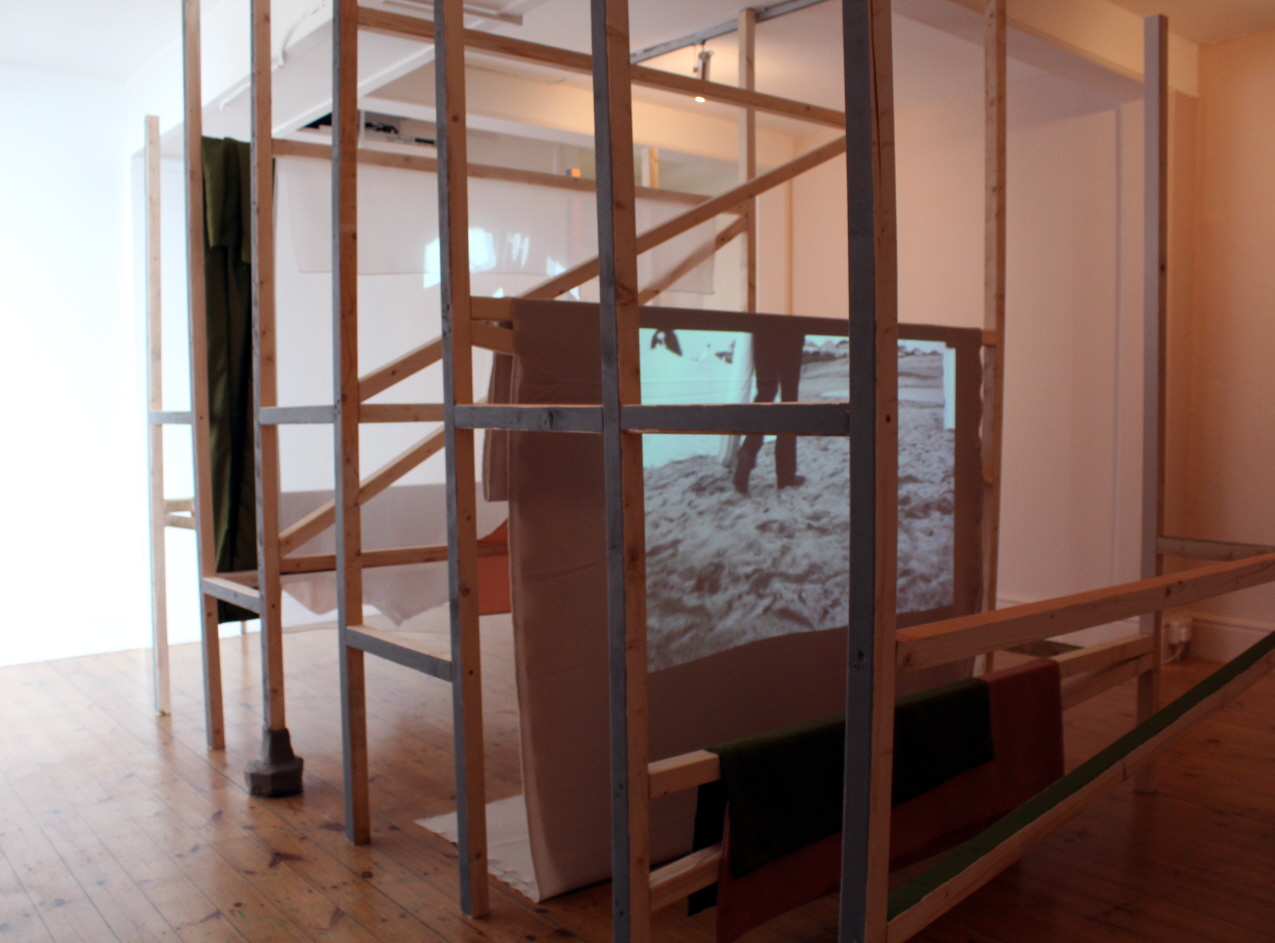
Emily Speed Littoral Zone - Plymouth Arts Centre
I had a bit of a moan a while back about the art world's seemingly wilful attempt to distract us from the big issues confronting the planet. However, there are two excellent exhibitions in Devon galleries at the moment that run counter to this trend.

S Mark Gubb's 'History is Written by the Winners' at Exeter Phoenix (28 March -10 May 2014) draws widely on the social and political culture of the 1980s and 1990s -- from fake Libyan hit squads (supposedly sent by Colonel Gaddafi to assassinate President Reagan in 1981) to conspiracy theories about the assassination of President Kennedy. The most prominent work (possibly because its familiar smell pervades the entire gallery) is A New Physics Based on Nightmares. This invites you to prepare Pot Noodles while timing your snack against the four-minute launch protocols for a nuclear attack.

Reading the gallery blurb is a must to get the best from this show - it's definitely art that needs commentary. Amusing yet pointed, it encourages a healthy scepticism about the structures of modern power.

Emily Speed 'Littoral Zone' at  Plymouth Arts Centre (22 March - 25 May 2014) is a much gentler, subtler show that takes its name from the unstable, liminal space between the high and low tide marks. Exploiting a small, gloomy gallery space to maximum effect, Speed uses projections, sound, sculpture and airstreams to create a space reminiscent of the drippy, dark, decaying spaces under a British seaside pier. There's a sense of shelter but also of vulnerability.

An improvised structure of timber and draped fabric (with feet of clay) is used as a rippling, unstable canvas for film of people doggedly erecting windbreaks on a bleak and breezy South Devon beach.  It's matched by images of sea defences and empty sands, and suggests our noble yet ultimately futile struggle against time, tide and the elements.

With the main railway link to Devon and Cornwall only recently re-opened after catastrophic sea damage, this work seems perfectly timed and perfectly placed.

Saturday, 29 March 2014

Documentation I

Gabrielle Hoad Five pigeons, 74 seconds (2014) Photo: Jamie Morrison
Work in progress for Solid Air, shown as part of PILOT in Artspace 101, University of Plymouth 24 March - 17 April 2014.  Laster sintered nylon model.

Documentation II

Gabrielle Hoad Interloper (2014) Installation view. Photo: Kevin Burrell
Part of my work Interloper in the conservatory at Oxford Botanic Garden. This large-scale vinyl banner is paired with an edition of 80 booklets for 'Breaking of tulips'  22 March -  26 May 2014. http://www.unwrappingbooks.info/#/breaking-of-tulips/4560059824

Thursday, 27 March 2014

Listening to Oxford

Hannah Rickards To enable me to fix my attention ... Installation at Modern Art Oxford (2014)
My recent visit to Oxford coincided with some brilliant exhibitions. At Modern Art Oxford I enjoyed Roelef Louw's Pyramid (Soul City), a carefully constructed pyramid of 6,000 oranges which gradually disappears as visitors help themselves to fruit (15 February - 6 April). It's rare for an art gallery to smell so good.

However, I was really there to see Hannah Rickards' To enable me to fix my attention on any one of these symbols I was to imagine that I was looking at the colours as I might see them on a moving picture screen (15  February - 21 April). Exploring extraordinary natural phenomena (thunder, the aurora borealis, mirages), the work consists of attempts to describe the indescribable. Rickards deconstructs, then reconstructs and transcribes these phenomena through text, light, sound, colour, first-person accounts and re-enactments. At first pass, it's a very restrained and minimalist show, but one that richly rewards proper investment of time and attention. I didn't want to leave.

A friend recommended the Audiograft Festival (12 March - 28 March at Oxford Brookes University and other city locations), which included Gordon Monahan's A Very Large Vinyl LP Constructed in Acoustic Space in The Glass Tank. You sit (alone and very conspicuously) in the centre of eight loudspeakers, where you hear a collage of surface scratches and vintage easy listening records, spinning to create the illusion that you're the hole in the middle of a virtual vinyl LP.

Even better was Christina Kubisch's Electrical Walk. It's a self-guided walk around the Oxford Brookes campus wearing special, sensitive wireless headphones which make the acoustic qualities of above-ground and underground electromagnetic fields audible. From lift control panels to vending machines and cashpoints, every electrical item has its own unique electromagnetic signature. Slightly ominous, but nonetheless a whole new way to experience the everyday.

Looking at other people's work is never easy when you've been obsessing about your own during an exhibition install, so it was a lucky coincidence to be able to spend so much time listening instead.

Oddly enough, the listening theme continued back in Exeter when I went to see an artist's talk by Marie Toseland. Rather than talk through a series of images, she played her own Desert Island Discs, as well as video clips of rapping and beatboxing.  All preparation for a new 'experimental opera' she's starting work on.

Wednesday, 26 March 2014

AA2A interim exhibition - Plymouth University

Kayleigh Hill The Balaclava Experiment PILOT AA2A show (2014)
PILOT: AA2A - Artspace 101, Roland Levinsky Building, University of Plymouth PL4 8AA

24 March - 16 April 2014 (by appointment only after 28 March, due to university holidays).

Exhibition of work in progress by the five artists resident at Plymouth University for the academic year 2013-14 as part of the national AA2A (Artists Access to Art Colleges) scheme:  Tabatha Andrews, Sally Hall, Kayleigh Hill, Gabrielle Hoad, Lee McDonald.

Features my work in progress The being beyond. A model representing 74 seconds in the flight of five flocking pigeons is shown alongside a digital reproduction of Pigeon En Vol (1891-92) by Etienne-Jules Marey and Georges DemenĂ¿, an early attempt to understand bird flight through the application of recording technology. Bird flight data provided by Dr Steven Portugal of the Royal Veterinary College, London.

Tuesday, 25 March 2014

'Breaking of tulips' - Oxford Botanic Garden


My work Interloper is showing at Oxford Botanic Garden 22 March - 26 May 2014. Entrance fees and opening times are here.

http://gabriellehoad.co.uk/interloper.php

Monday, 3 March 2014

Southwest shows catch-up

Installing Peter Randall-Page - Photo: Plymouth City Museum & Art Gallery

Running around over the past few days to catch up with a number of South West exhibitions before they close later this month.

The Jerwood Drawing Prize 2013 is currently visiting Plymouth College of Art and Plymouth Arts Centre. As in previous years, the show has quite a focus on technical virtuosity, but this time many more of the most beautifully executed drawings also had something to say. I'm particularly haunted by Roy Eastland's gentle and meticulous homage (in delicate silverpoint on gesso) to the victims of the The Great Folkestone Air Raid of May 1917: “They looked like silver birds. The sun was shining on them...” In Plymouth until 9 March 2014, then at the Sidney Cooper Gallery, Canterbury Christ Church University.

Dartmoor-based sculptor Peter Randall-Page has his first major exhibition in the Southwest for 25 years, showing at Peninsula Arts at Plymouth University and Plymouth City Museum and Art Gallery. Inspired by the mathematical structures underlying nature, the work consists of a number of heavyweight sculptures in marble and stone alongside more modest (and much more likeable) works on paper. Through pouring, dripping and blotting, the artist has coaxed his ink into symmetrical branching structures that recall the veins of leaves or the branches of evolutionary family trees. Until 29 March 2014.

Outrageous Fortune: Artists Remake the Tarot continues at Exeter Phoenix until 15 March 2014, showcasing works by 78 diverse artists that interpret the famous deck of cards. The story behind the show adds to its impact, so it's a pity more people didn't come to hear curator Andrew Hunt talk about it last Saturday. It's significant that this body of work, focused on prediction and fortune-telling, was commissioned in 2008 at the start of the world economic crisis. Also that its evolution involves a complex and mischevious network of gifts and exchanges.

Steven Paige's A Treatise on Beasts (after Physiologus) continues at the Forum, University of Exeter until 25 March. Featuring both new works and items drawn from personal and historic archives, it presents a collection of beasts - both ancient and modern.
The work was developed during a residency with Exeter's Double Elephant Print Workshop as a response to the Ted Hughes and Leonard Baskin archive, held in the University of Exeter Special Collections.

Sunday, 2 March 2014

B is for bananas, birds, bud-grafting and busy

Lots of projects coming to a head right now. My work Interloper for 'The breaking of tulips' at Oxford Botanic Garden has just gone off to the printers, ready for installation in the third week of March. It's about bud-grafting - a subject drawn at random for me by the curators from back-copies of The Gardeners Chronicle. (Opens 22 March and runs until 26 May 2014).

Immediately afterwards, I'm doing a small show at Plymouth University's Room 101 with my fellow artists on the Artists Access to Art College scheme. I'm hoping to show two 3D prints of bird flights (part of the Solid Air project), which should be going into production this week. The AA2A show runs 24 to 28 March 2014.

My long-term art and ecology project Foreign Soil continues, boosted by support from the ESI/RANE Creative Exchange Programme. We're expecting delivery of our first (baby) banana plants next week and will be visiting a local farm to look at microclimates where they might be grown outdoors the week after.

Creative exchanges between art and science

I'm delighted to announce that I've joined the ESI/RANE Creative Exchange Programme as a Creative Affiliate. ESI/RANE is the research group of the University of Exeter's Environment & Sustainability Institute and Falmouth University's Research in Art, Nature and the Environment.

I'm going to be working with Dr Jonathan Bennie, ESI Associate Research Fellow, to further develop my project Foreign Soil

The collaboration, which runs until January 2015, will model and map biologically relevant microclimates in order to support a more informed investigation of the feasibility of banana cultivation – now or in a future climate scenario. As well as opening up conversations about climate change and food security, we hope this work will offer insights into ways of visualising and communicating complex spatial and temporal patterns of microclimate within landscapes.

Blog Archive

Followers