Friday, 25 February 2011

The less said the better?

Barry Sykes Popular Problems #3

A flying visit to Plymouth to see three current art shows. Taking Time: Craft and the Slow Revolution is a touring exhibition from Craftspace that celebrates the often-painstaking processes of creative making.

Amy Houghton Cardigan Study
Amy Houghton's spooky animation is a highlight; it shows a child's knitted cardigan being unravelled by unseen hands. My own preoccupation with measurement meant Sue Lawty's Calculus was also a draw. Consisting of hundreds of small, weathered stones sorted into groups and arranged rhythmically on a gesso surface, it contrasts human time (and counting) against geological time. Neatly summing up the show's 'slow' theme, it demonstrates the investment of care and skill required of makers - a requirement that rarely correlates to market value. It's a pity that such lucid visual statements had to be weighed down with so many wordy panels and labels. The texts would have been much less obtrusive on a photocopied sheet.

On to Dominion by Angela Cockayne, a solo show which documents the artist's diverse responses to the mythical and natural histories of the sperm whale. Informed by Melville's Moby Dick and Philip Hoare's Leviathan, Cockayne's work also powerfully communicates that strange mixture of awe, primordial connection and brutal commerce that defines humankind's relationship with the whale. I found individual objects in the show potent and intriguing, but was also overwhelmed by the sheer quantity of different ideas in such a small space. My instinct is that, with a good edit, this collection of work could say much more.
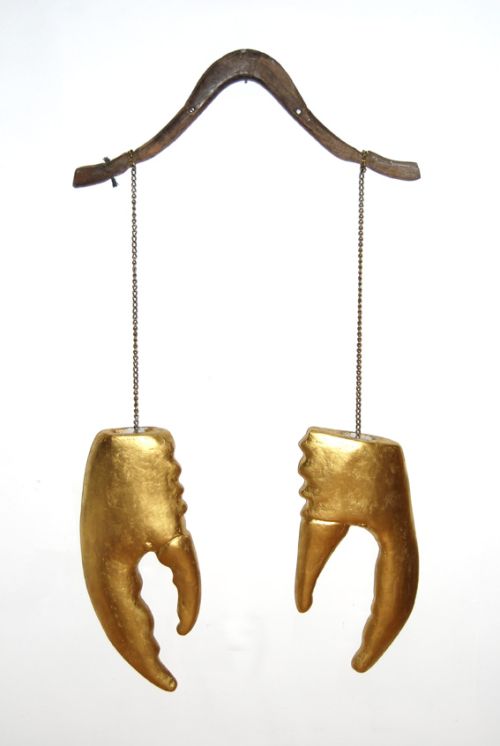
Angela Cockayne Yoke aka I must stop making things


After this deluge of ideas, it's something of a relief to encounter the Barry Sykes exhibition at Plymouth Arts Centre, where there's lots to think about but plenty of space to think in. Sykes specialises in the kind of playful, light-touch art that people often assume is just a throwaway joke - but there's real substance here. He has a fertile imagination and razor-sharp curiosity about the way the world works.

I enjoyed The Charter or Terms of Engagement an official-looking document which highlights the uncertainties (and the freedoms) that artists experience when working outside traditional institutions.  Popular Problems is a group of concrete-based sculptures (pictured top) that I found totally compelling, if hard to explain. I looked them up later on his website and discovered they were inspired by an adhesives marketing exercise, which only made me love them more.

And finally, as the theme for today seems to be 'less is more', I should mention The Least Most (The Most Least?) a film documenting Sykes' visit to a tattoo parlour to get the tiniest possible tattoo. A dot.

Barry Sykes: Recreate a Nervy Pistol (An Early Retrospective) is at Plymouth Arts Centre until 27 February 2011

Angela Cockayne: Dominion is at the Peninsula Arts Gallery until 5 March 2011

Taking Time: Craft and the Slow Revolution is at Plymouth City Museum and Art Gallery until 9 April 2011

Wednesday, 23 February 2011

Exeter gets animated

Down to the city centre at the weekend to catch Isca Obscura, a giant animation projected on to Exeter Cathedral as part of the city's annual Animated Exeter festival.  Created by Tundra* with a haunting score by Beth Gibbons (of Portishead), it drew on local history and mythology, including the devastating blitz of 1942 and the gory legend of St Sidwella, whose blood supposedly became the wells that fed the city's water supply.

There are animation-related events and exhibitions at various venues throughout the city until 26 February. Read my review (and others' reviews) of Landings: Reviewing the World at Spacex here.

Monday, 14 February 2011

Art as social project

West Town Farm, 13 February 2011
This Sunday, I spent a few hours at West Town Farm in Ide being shown around by organicARTS co-ordinator Christine Duff.  This arts and education project has been going for about six years, providing access to an organic farm for anyone who wants to support or learn more about sustainable agriculture.

It's led to spin-off projects such as Love Local Food, a mobile food shop, and the Community Environment Group which works with people with mental health issues. They have also revitalised a once-failing dairy farm, encouraging its development as a community and environment resource and helping to access money that has funded footpaths, orchards, volunteer workers, a beef herd, pigs and bees - amongst other things.

Founders Christine Duff and Jo Cotter are artists, and were bemoaning the fact they've had very little time to pursue their own practice and 'make' things. At the time I nodded sympathetically - it's often true that artists who are the most capable and outward-looking end up spending the least time on their own work. But, on reflection, I think they might be worrying unnecessarily. You only have to look at someone like Suzanne Lacy to realise that Christine and Jo have never stopped making things.  They've been making  huge, complex, creative, meaningful, amazing things for years. It's simply a matter of how you frame the work of an artist.

By contrast, lots of object-like things are made at and for organicARTS by artists, students, local schools and community groups.  I made my own Observatory as a site-specific piece for the farm in 2009, and I loved working there.  But I will also admit to feeling that there's something pointless about adding to the world's accumulation of stuff  in a place where there's so much real work to be done. To my mind, West Town Farm calls for a little less artistic romanticism and a little more artistic activism.

On the case with Off The Hook

Sally Howkins Law, Probability and Risk (2010) Two digital photo frames showing randomized stills.
Finally managed to install Sally Howkins' video work Law, Probability and Risk in the window of local clothing store Off the Hook. The project is an offshoot from an earlier collaboration between Exeter's independent traders and an artist-led curating project Found Space. The proprietor of the Off The Hook wanted to continue his association with visual artists and asked Found Space to help.

It's been a delicate balance finding a piece of work that can hold its own in a busy shop window, while working round the business requirements of the owner and manager of the store.  Even after the success of our earlier project Stowage, I have some misgivings about placing artworks in the retail environment. I like the idea of taking work out of the gallery into the real world but, unless the work is made specifically for the location, the outcome can be an odd hybrid of art and window dressing. Sally Howkins has been very generous and open-minded in loaning her work for this slightly experimental purpose.

Dealing with notions of probability and crime detection, Law, Probability and Risk also looks at the narratives left behind when we touch a surface.  It celebrates the unique identity of individual human beings and questions our reliance on probability in making important decisions about people’s lives.

Tuesday, 1 February 2011

Seeing double

Duplicity (2010)
I've almost resolved a piece of work called Duplicity: three mirrors paired with found zoological texts to make little sets of wings. Then arranged in a flock on the wall, a bit like traditional flying ducks.  It's been sitting in my studio as an idea for months, but I've only just worked out a way of displaying it properly.

I think it's about perceptual construction and scientific dissection, but it also plays off a theme of translating three-dimensional movement to 2D surfaces that often crops up in my work. Except this time it's the other way round - the two-dimensional diagrammatic wings are taking flight with the help of mirrors.  There's a kind of trickery to it - hence duplicity - but also doubling, as in duplicated.

Three pieces each 15cm x 15cm x 15cm
Mirrors, ceramic tiles, found texts

Blog Archive

Followers