
 |
| Three pigeons, 127 seconds | Laser sintered nylon 20 x 25 x 6cm |
Saturday, 20 September 2014
Taking flight

Monday, 15 September 2014
Listen to Easterbrooks
 |
| Listen to Easterbrooks | 2014 | 50-minute sound sequence, looped, with digital imagery |
These
measurements of soil and air temperatures were made as part of a
collaboration with Dr Jonathan Bennie,
an Associate Research Fellow at Exeter University’s Environment and
Sustainability Institute. The project,
Foreign Soil, asks
what it means to eat local food, through a documented attempt to grow
edible dessert
bananas (Dwarf Cavendish) outdoors in Devon.
It's on just for one week at OrganicArts, West Town Farm, Ide, nr Exeter, Devon EX2 9TG. 11am-6pm daily. It's installed in a stable in the farmyard, but you can also listen on mobile devices in Easterbrooks itself.
Foreign
Soil is supported by the ESI/RANE Creative Exchange Programme and
OrganicArts. Technical Consultant: Tim King.
Monday, 18 August 2014

Monday, 28 July 2014
AA2A show at Plymouth's Civic Centre

I'll be showing three working drawings from my digital visualisation/bird flight project 'Solid Air'. It takes place at the Plymouth City Council House, Civic Centre, Armada Way, Plymouth PL1 2AA. The exhibition is open to the general public every Friday in August (1st, 8th, 15th, 22nd and 29th) between 12.00 and 2.00pm. There will be a closing event 4.00pm-5.30pm on 29th August as part of the city-wide Open 4 multi-venue arts event organised by Visual Art Plymouth.
Part of Plymouth's Civic Centre Precinct, The Council House dates from 1954. Its post-war interior is of national significance and provides a fantastic backdrop for a rolling programme of exhibitions by contemporary artists with a connection to Plymouth. The programme is supported by Plymouth City Council.
You can find out more about The Council House exhibitions programme here:
http://councilhouseart.wordpress.com/about/
Sunday, 29 June 2014
Foreign Soil Field Trip
 |
| "Throw a hoop to pick a random patch of ground. Log, describe and count everything you find there." Field Trip - 29/06/14. |
Friday, 11 April 2014
Textually Active with Driftingspace
 |
| Gabrielle Hoad - Data roll |
Textually Active took place at Karst, Plymouth on 10 April 2014 with contributions from Tabatha Andrews, Sally Hall, Jason Hirons, Gabrielle Hoad, Rosie King, Holly Knowles and Steven Paige. Fifty-five people attended.
For the event, I considered source data from my flight mapping project (generated by glider pilot Rowan Smith and research scientist Dr Steven Portugal) as text. This included transcribing two seconds of pigeon flight data through automated text-to-voice software and presenting it alongside animated archive images of bird flight by E.J. Marey from the early 1890s.
The session focused on seeing, hearing and holding data (printed out as a roll)
which allowed us to appreciate the its
rhythms, its sheer
quantity and density, and also its narrative qualities (it describes a connected series of events). But, despite their precision, numeric co-ordinates are too abstract for ordinary human comprehension when presented this way. They have to be
translated and contextualised.
Common themes emerged from the evening around data, surveillance, linear progression (narratives), digital processes (binary states), rule-based works, and measurement of space and time. Details of the other artists' work can be found here.
Common themes emerged from the evening around data, surveillance, linear progression (narratives), digital processes (binary states), rule-based works, and measurement of space and time. Details of the other artists' work can be found here.
Textually Active provides a critical space for debate and performative practices in Plymouth and the South West of England. Curated and run by Driftingspace, a collaborative art practice, it's an ad hoc, nomadic event running cultural activities that incorporate art, performance, installation, and writing.
Saturday, 5 April 2014
Art that isn't looking away #4
 |
| Emily Speed Littoral Zone - Plymouth Arts Centre |
S Mark Gubb's 'History is Written by the Winners' at Exeter Phoenix (28 March -10 May 2014) draws widely on the social and political culture of the 1980s and 1990s -- from fake Libyan hit squads (supposedly sent by Colonel Gaddafi to assassinate President Reagan in 1981) to conspiracy theories about the assassination of President Kennedy. The most prominent work (possibly because its familiar smell pervades the entire gallery) is A New Physics Based on Nightmares. This invites you to prepare Pot Noodles while timing your snack against the four-minute launch protocols for a nuclear attack.
Reading the gallery blurb is a must to get the best from this show - it's definitely art that needs commentary. Amusing yet pointed, it encourages a healthy scepticism about the structures of modern power.
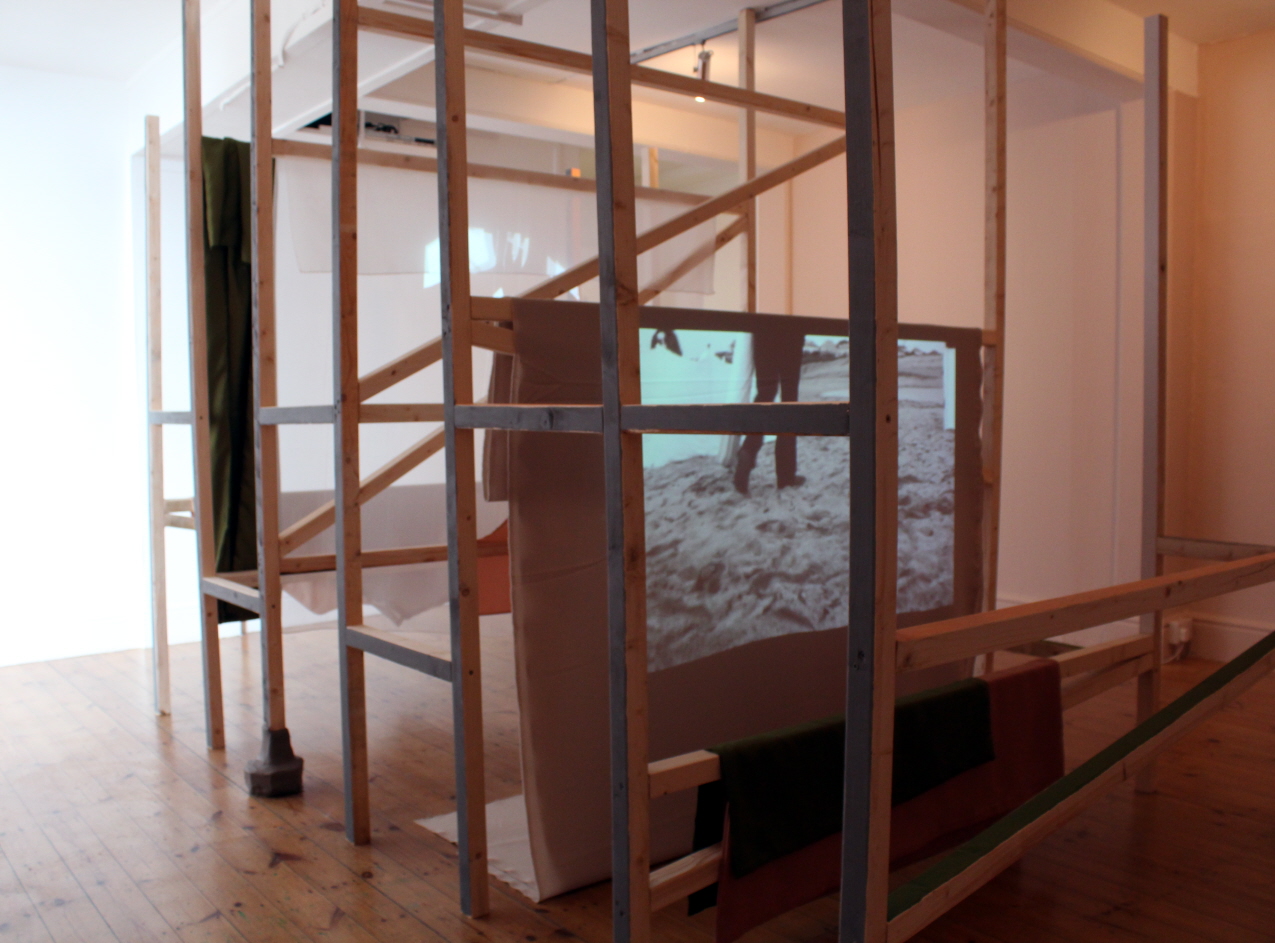
Emily Speed 'Littoral Zone' at Plymouth Arts Centre (22 March - 25 May 2014) is a much gentler, subtler show that takes its name from the unstable, liminal space between the high and low tide marks. Exploiting a small, gloomy gallery space to maximum effect, Speed uses projections, sound, sculpture and airstreams to create a space reminiscent of the drippy, dark, decaying spaces under a British seaside pier. There's a sense of shelter but also of vulnerability.
An improvised structure of timber and draped fabric (with feet of clay) is used as a rippling, unstable canvas for film of people doggedly erecting windbreaks on a bleak and breezy South Devon beach. It's matched by images of sea defences and empty sands, and suggests our noble yet ultimately futile struggle against time, tide and the elements.
With the main railway link to Devon and Cornwall only recently re-opened after catastrophic sea damage, this work seems perfectly timed and perfectly placed.
Subscribe to:
Posts (Atom)