
Lots of projects coming to a head right now. My work Interloper for 'The breaking of tulips' at Oxford Botanic Garden has just gone off to the printers, ready for installation in the third week of March. It's about bud-grafting - a subject drawn at random for me by the curators from back-copies of The Gardeners Chronicle. (Opens 22 March and runs until 26 May 2014).
Immediately afterwards, I'm doing a small show at Plymouth University's Room 101 with my fellow artists on the Artists Access to Art College scheme. I'm hoping to show two 3D prints of bird flights (part of the Solid Air project), which should be going into production this week. The AA2A show runs 24 to 28 March 2014.
My long-term art and ecology project Foreign Soil continues, boosted by support from the ESI/RANE Creative Exchange Programme. We're expecting delivery of our first (baby) banana plants next week and will be visiting a local farm to look at microclimates where they might be grown outdoors the week after.
Sunday, 2 March 2014

Creative exchanges between art and science
I'm delighted to announce that I've joined the ESI/RANE Creative Exchange Programme as a Creative Affiliate. ESI/RANE is the research group of the University of
Exeter's Environment & Sustainability Institute and Falmouth
University's Research in Art, Nature and the Environment.
I'm going to be working with Dr Jonathan Bennie, ESI Associate Research Fellow, to further develop my project Foreign Soil.
The collaboration, which runs until January 2015, will model and
map biologically relevant microclimates in order to support a more
informed investigation of the feasibility of banana
cultivation – now or in a future climate scenario. As well as opening up conversations about climate change and food security, we hope this work will offer insights into ways of visualising and communicating complex spatial and temporal patterns of microclimate within landscapes.
Tuesday, 17 December 2013
Hands-on 3D printing (in clay)
 |
| Icebergs - digital pots by Jonathan Keep (www.keep-art.co.uk) |
I've discovered another hands-on way of practising digital printing, this time using a paste of extruded porcelain driven by compressed air. You mix the clay and fill the cartridges yourself, and spoon powdered clay around the form to support it as it's built. (An alternative is to dry it with a hairdryer to harden the structure as it forms.)
It's demonstrated here by ceramicist Jonathan Keep.
http://www.youtube.com/watch?v=VxNzo3ckVOo
The only problem from the point of view of my project is that the process is restricted to creating cylinders. The cylinder shape can be deformed in any way, but you need to design for a continuous extrusion of wet clay.
Thursday, 12 December 2013
Art as measurement
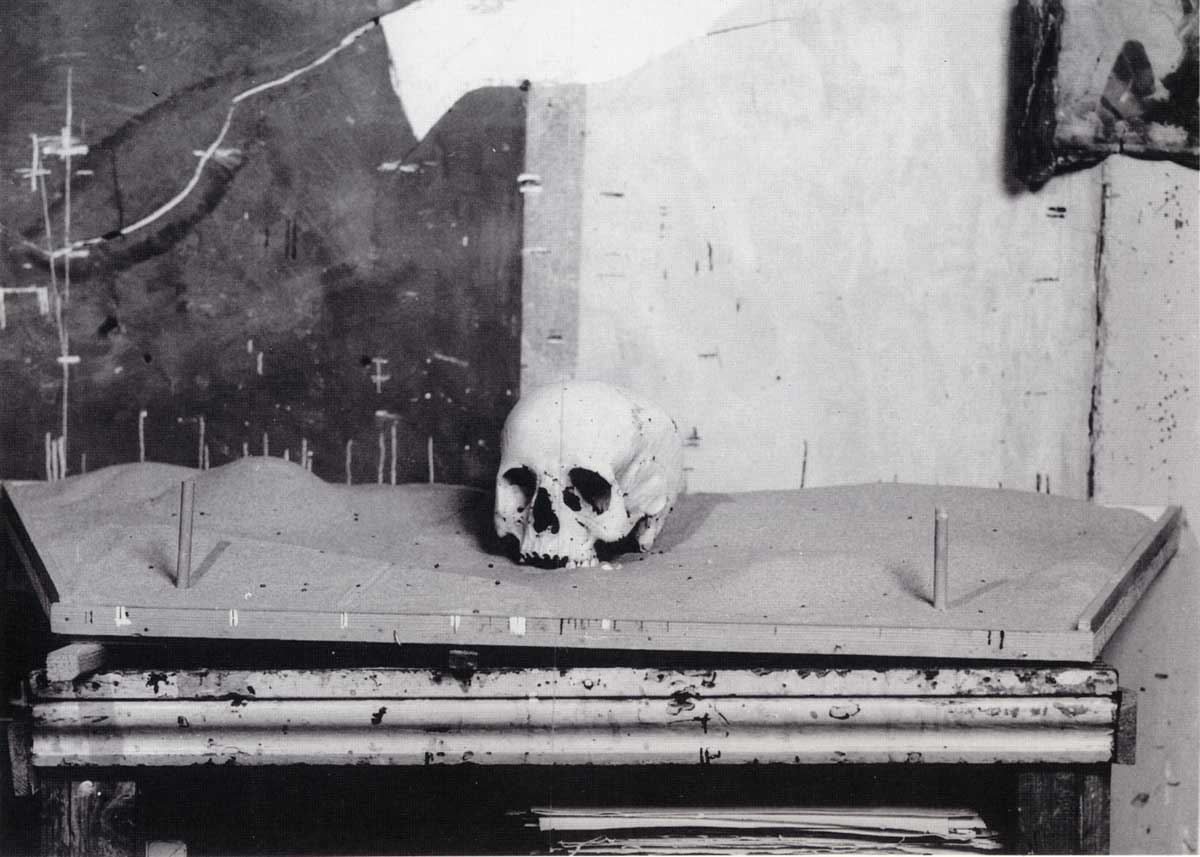 |
| Euan Uglow - Studio set up for Skull 1994-7 |
There is some discussion of Uglow's process (with illustrations) by Neil Plotkin on the Painting Perceptions blog.
Lampert, C. (2007) Euan Uglow: The Complete Paintings London: Yale University Press
Tuesday, 3 December 2013
Hand-crafted computing
 |
| 'Failed' test print of flight data using MakerBot |
As part of my AA2A placement, I've been able to work with a technican at Plymouth University to create a test model with a MakerBot . (This is the DIY end of the 3D printing spectrum and forms models by layering a melted a plastic filament.) I used existing glider GPS so I could compare the results with high-end laser sintering. Technically it was a failure - too fragile and something of a misprint, but I was really pleased with the slightly messy 'spun sugar' effect, which showed me the data in a new light. It was also great to have another solid object in my hands.
Second, the manipulation of the flight data from a flock of pigeons is now moving along much faster. There have been a number of false starts, partly due to the sheer quantity of data but, with the help of a programmer, I'm now some way to having a simple interface that allows me to turn streams of numbers into quick digital sketches and look for interesting flight patterns. It's this ability to work directly with the data - coupled with the tailor-made programming - that's helping me feel much more like a maker working with other makers than a project manager.
Monday, 18 November 2013
Drawing as a parallel activity

I've been thinking about serial and parallel
processes in image making, with reference to an essay by the
mathematician and philosopher Brian Rotman. I
find this essay particularly interesting because it begins with the
analogy of a flock of starlings and a discussion of two modes:
the serial, which consists of doing one thing after another (the whole flock forming itself and moving through time) and the parallel (each starling flying in concert with the others) doing many things at once. (2000: 57)
He goes on to point out that, even
though an image is read by sequential eye movements, its parts are
perceived simultaneously as a whole or in parallel.
By
contrast, the process of drawing might appear to be serial (look, make
mark, look again, make another mark). But, in fact, freehand
observational drawing isn't a simple matter of conveying bits of what you see one by one onto paper. A good mark is usually made in relation to the whole subject (using a kind of peripheral vision) and in the context of the whole set
of other marks already made. So although it is transferred to the paper
in serial actions, the thought processes of an observational drawing
are often parallel in nature.
I'm
thinking that, as with Ingold, this might provide some insights into
the differences between digital drawings (and models) created from
co-ordinates and hand-made observational drawings (and models) for my project Solid Air.
Rotman, B (2000) 'Going Parallel' in SubStance #91 pp56-79
Monday, 11 November 2013

Subscribe to:
Posts (Atom)