
I've been awarded a place on the national Artists Access to Art Colleges scheme and will be spending approximately one day a week at Plymouth University over the 2013-14 academic year, doing research in support of my bird flight project Solid Air. While I'm there, I'll also be sharing aspects of my practice with students.
Having been introduced to the facilities and put up an informal introductory exhibition with the other artists (Tabatha Andrews, Sally Hall, Kaleigh Hill, Lee McDonald and Jamie Barber) my first period of hands-on work was to join the weekly life class.
I wanted to explore in a practical way the differences between drawing freehand with pencil on paper and
creating digital drawings from data. What most
interests me is the contrast that Tim Ingold describes in relation to
line-making between 'the trace of a gesture' and 'an assembly of point-to-point connectors' (2007: 74-75).
A freehand drawing evolves during a process of discovery as marks are
made and remade in response to the model. In Ingold's terms it is
'laying a trail as one goes along' (ibid.: 76). Similarly, when
flying free, the bird maintains an overall goal such as searching for
food, but makes its path through the air by responding to different
stimuli in the environment (such as air currents).
However, by contrast, when flight co-ordinates collected by a bird
are transcribed and plotted on the computer screen or digital printer,
the drawing (or 3D print) is made by a process whereby 'every successive
destination is already fixed prior to setting out' (ibid.: 73).
Ingold, T. (2007) Lines: A Brief History London: Routledge
Sunday, 3 November 2013

Tuesday, 22 October 2013
Art that isn't looking away #2
 |
| Taylor Wimpey show home interior at new Devon town of Cranbrook |
It included a surreal and slightly depressing trip to the new town of Cranbrook on Exeter's outskirts. Given a blank sheet of paper, you'd have hoped Devon could do better. There's a lot of talk in the publicity about community and environment, but no real commitment to it in the way this new settlement been designed or constructed. That's what happens when you hand over your civic planning responsibilities to private developers, whose first responsibility is to deliver a return for their shareholders, not invest in a sustainable community. It was, however, great fun exploring the show homes...
Where to build the walls that protect us was conceived by Stephen Hodge and commissioned by Kaleider.
http://www.wheretobuildthewallsthatprotectus.com/
Storify by Mark McCarthy http://storify.com/markpmcc/where-to-build-the-walls-that-protect-us-excursion
Sunday, 13 October 2013
Art that isn't looking away #1: Upstream Color

So much has been written about it (see below), I don't need to start over, except to mention the way the film references materiality as part of a wider shift in consciousness. We see all sorts of analogue technology: printed books, hand written notes, cassette decks, vinyl records, gold coins. Meanwhile, the characters are constantly - almost obsessively - touching things. The narrative and ideas are conveyed more through sound, music and imagery than words. This sensuous world seems to feature as a counterpoint to or defence against the increasingly blurred boundaries between our 'true' selves and the digitised, biomedical extensions we're engineering.
Upstream Color trailer
Short essay on Upstream Color by Dr Matt Hayler of Exeter University
Reviews of Upstream Color
http://www.independent.co.uk/arts-entertainment/films/reviews/jonathan-romney-on-upstream-colour-come-on-in-the-water-is-dazzling-8792730.html
http://www.newyorker.com/online/blogs/movies/2013/04/the-cautionary-rhapsody-of-upstream-color.html
http://www.theguardian.com/film/2013/aug/29/upstream-color-review
Sunday, 6 October 2013
Looking the other way
 |
| Charlie Godet Thomas Unfurl |
Artists will make the art they have to make. But curators, selectors, funders and buyers - they decide what kind of art is pushed to the fore. What gets the exposure and the backing, the gallery space and the broadcast time. In Exeter, two recent - and accidentally related - exhibitions highlight a growing taste for a more old-fashioned type of arty art. Consciously or unconsciously, opinion-formers in contemporary art seem engaged in either a silent scream of existential denial, or blatant complicity with the affluent elite.
In both exhibitions there's an over-riding concern with materiality - the physical substance of the works rather than their context or meaning. At Spacex, Lucy May is showing wax sculptures that have the colour of viscera and the form of baroque decorative embellishments. They are delicious yet slightly disgusting, full of movement yet still. Alongside this work, Lisa Watts is creating live art in the gallery as part of her research project Skittish. This work will unfold over the coming weeks but, at the opening, Watts talked about her ideas growing spontaneously out of a response to materials, and specifically not from any issues or political stance.
At the nearby Exeter Contemporary Open, there's work by nine artists selected from a national competition. It's not thematically curated but you'd never know it. The work is accomplished and interesting but, as far as I can see, none of it is about much apart from its own physical qualities. The strangeness of one material set against another, the humour of correspondences, the fascination of repetition, colour and pattern...
"The expression that there is nothing to express, nothing with which to express, no desire to express, along with the obligation to express."
Samuel Beckett from the Duthuit Dialogues as quoted by Charlie Godet Thomas in the Exeter Contemporary Open 2013 catalogue.
At this point in time - this very critical point - is there really nothing more important with which to fill our galleries than stuff about stuff? Whose agenda is that serving? Or are the problems we face so huge we actually can't look them in the eye any more?
Skittish (Lisa Watts and Lucy May) - Spacex - 28 September–23 November 2013
Exeter Contemporary Open (Charlie Godet Thomas, Rachel Busby, Rebecca Ounstead, Max Cahn, Julie Price, Anne Deeming, Malina Busch, Oliver Tirre, Hannah Mooney) - Exeter Phoenix -
19 September–2 November 2013
Monday, 30 September 2013
The price of everything and the value of nothing
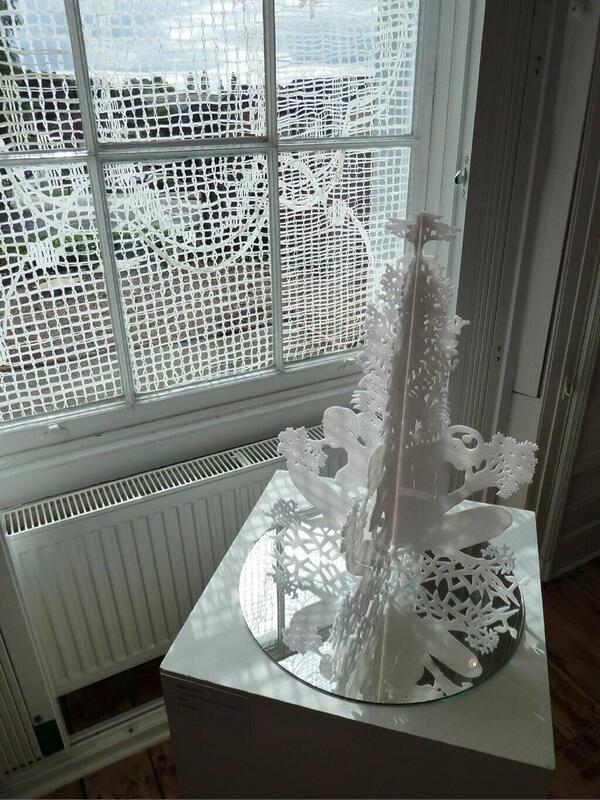 |
| intoLACE featuring work by Andrea Stokes and Helen Snell |
Artists need to earn a living, I know. And earning a decent living from your work isn't incompatible with artistic credibility. But I see far too many shows in Devon where curators act more like retailers.
In my opinion, intoLACE at the Thelma Hulbert Gallery in Honiton fails to successfully negotiate this - admittedly tricky - territory. Based in a town famed for its lace-making, the gallery is the former home and studio of artist Thelma Hulbert, who died in 1995. The show and the setting offers a great opportunity to consider women's labour, women's creativity and the perceived value of women's work in society over time.
The flagship piece, Andrea Stokes' installation Net Curtains succeeds brilliantly in this respect. Over two days, under the guidance of the artist, some 25 local women transferred a drawing onto every single window of the gallery. Inspired by traditional Honiton Lace the drawing weaves over the entire gallery, creating the illusion of net curtains and making the building feel domestic and intimate. Significantly, the women were paid £250 each for their work. I assume the artist took a fee too. But, as a temporary installation, the work itself has no price tag.
Equally, a series of fabulous intricate life-size in drawings of lacy stockings and tights from a series called Bluestockings by Catherine Bertola are marked not for sale.
But work by other participants is presented as an odd hybrid of serious art and homewares. In Helen Snell's case, the same sculpture is shown four times in different sizes and materials. There's a bit of arty bluster about imperfect copies and subverting the idea of an edition, but it's rather undermined by the fact each has its own different price point. And exit through the gift shop please to buy Imogen Luddy's quirky plates and cake stands - just like the ones you saw in the gallery.
Please understand that I have no problem with applied arts - with makers basing their practice on sound concepts, or with the public acquiring beautiful, individual and creative pieces for their homes. What troubles me is the muddle we're in here between meaning and selling. It's like IKEA trying to persuade you to buy a wardrobe by quoting Deleuze. It makes the artists' statements sound like pretentious and ultimately insincere sales patter.
I lay this problem at the feet of the curator, not the artists, who all seem to be producing very sound work. A bolder over-arching interpretative statement, a more rigorous editing of work (to avoid the feeling of a shop display) and the production of a separate price list would all have gone a long way to giving this exhibition the credibility it deserves.
IntoLACE 14 September 2013 - 02 November 2013 at Thelma Hulbert Gallery, Honiton and Devon Guild of Craftsmen, Bovey Tracey.
Tuesday, 17 September 2013
The mechancial versus the magical
 |
| Flight data 1ame7c21 - GPS co-ordinates on paper roll (2013) |
I'm showing my prototype 3D printed flight The Geometry of Air, which is concerned with the transition of a durational, ephemeral drawing in space (a glider flight) to a tangible, fixed object.
The Musgrove Gallery is a great space because of the diversity of its audience and its incredible footfall, but it does require work to be a little more explanatory and accessible. So I've taken it as an opportunity to include an aerial view of the location of the glider flight, the complete GPS data set on a roll (which creates its own beautiful, rhythmic pattern on the paper), the digital working drawing, and the 3D print itself.
I'm always wary of explaining too much and leaving no room for the audience to think or wonder. Explanation can crowd out the magical ability of art to make new and intuitive connections. At the same time, I'm entranced by the process of making images and models from numbers and want to share this with an audience.
It's turned out to be an interesting step in relation to my related R&D project Solid Air, as one of the issues I'm thinking about there is how to contextualize and interpret such work for curators and audiences. I've enjoyed this opportunity to push at the rational side of the project, not least because it invites a more oblique approach next time.
'Drawn Together' runs until 11th November 2013 - Musgrove Park Hospital, Taunton, Somerset TA1 5DA
http://www.artforlife.nhs.uk/
Thursday, 22 August 2013
The public and the private city

Subscribe to:
Posts (Atom)