Monday, 30 September 2013

The price of everything and the value of nothing

intoLACE featuring work by Andrea Stokes and Helen Snell
When I see a price next to a piece of art, I can't help myself: I stop thinking about what it might be trying to tell me and start thinking of it as a commodity.  I become much more concerned with whether it pleases me, whether it's worth the price, whether it's something I might want to own and use.

Artists need to earn a living, I know. And earning a decent living from your work isn't incompatible with artistic credibility. But I see far too many shows in Devon where curators act more like retailers.

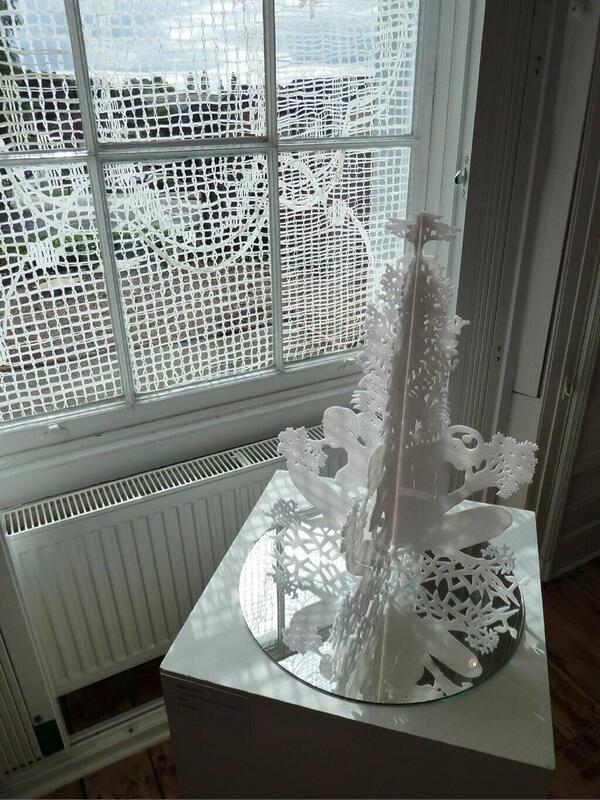
In my opinion, intoLACE at the Thelma Hulbert Gallery in Honiton fails to successfully negotiate this - admittedly  tricky - territory.  Based in a town famed for its lace-making, the gallery is the former home and studio of artist Thelma Hulbert, who died in 1995.  The show and the setting offers a great opportunity to consider women's labour, women's creativity and the perceived value of women's work in society over time.

The flagship piece, Andrea Stokes' installation Net Curtains succeeds brilliantly in this respect. Over two days, under the guidance of the artist, some 25 local women transferred a drawing onto every single window of the gallery. Inspired by traditional Honiton Lace the drawing weaves over the entire gallery, creating the illusion of net curtains and making the building feel domestic and intimate. Significantly, the women were paid £250 each for their work.  I assume the artist took a fee too. But, as a temporary installation, the work itself has no price tag.

Equally, a series of fabulous intricate life-size in drawings of lacy stockings and tights from a series called Bluestockings by Catherine Bertola are marked not for sale.  

But work by other participants is presented as an odd hybrid of serious art and homewares. In Helen Snell's case, the same sculpture is shown four times in different sizes and materials. There's a bit of arty bluster about imperfect copies and subverting the idea of an edition, but it's rather undermined by the fact each has its own different price point. And exit through the gift shop please to buy Imogen Luddy's quirky plates and cake stands - just like the ones you saw in the gallery.

Please understand that I have no problem with applied arts -  with makers basing their practice on sound concepts, or with the public acquiring beautiful, individual and creative pieces for their homes.  What troubles me is the muddle we're in here between meaning and selling. It's like IKEA trying to persuade you to buy a wardrobe by quoting Deleuze. It makes the artists' statements sound like pretentious and ultimately insincere sales patter.

I lay this problem at the feet of  the curator, not the artists, who all seem to be producing very sound work.  A bolder over-arching interpretative statement, a more rigorous editing of work (to avoid the feeling of a shop display) and the production of a separate price list would all have gone a long way to giving this exhibition the credibility it deserves.

IntoLACE 14 September 2013 - 02 November 2013 at Thelma Hulbert Gallery, Honiton and Devon Guild of Craftsmen, Bovey Tracey.

Tuesday, 17 September 2013

The mechancial versus the magical

Flight data 1ame7c21 - GPS co-ordinates on paper roll (2013)
I've been installing work for ' Drawn Together' at the Musgrove Park Hospital in Taunton. Curated by Sara Dudman, this show brings together a number of approaches to drawing which have a technical or mechanical orientation, from architectural sketches and CAD drawings to botanical illustration and hand-drawn process pieces.

I'm showing my prototype 3D printed flight The Geometry of Air, which is concerned with the transition of a durational, ephemeral drawing in space (a glider flight) to a tangible, fixed object.

The Musgrove Gallery is a great space because of the diversity of its audience and its incredible footfall, but it does require work to be a little more explanatory and accessible. So I've taken it as an opportunity to include an aerial view of the location of the glider flight, the complete GPS data set on a roll (which creates its own beautiful, rhythmic pattern on the paper), the digital working drawing, and the 3D print itself.

I'm always wary of explaining too much and leaving no room for the audience to think or wonder. Explanation can crowd out the magical ability of art to make new and intuitive connections. At the same time, I'm entranced by the process of making images and models from numbers and want to share this with an audience.

It's turned out to be an interesting step in relation to my related R&D project Solid Air, as one of the issues I'm thinking about there is how to contextualize and interpret such work for curators and audiences. I've enjoyed this opportunity to push at the rational side of the project, not least because it invites a more oblique approach next time.

'Drawn Together' runs until 11th November 2013 - Musgrove Park Hospital, Taunton, Somerset TA1 5DA  
http://www.artforlife.nhs.uk/

Thursday, 22 August 2013

The public and the private city

"A view can belong to you, even if the land itself doesn't...". Something I've written about This City's Centre 1: Window by Blind Ditch, which is showing at the Royal Albert Memorial Museum, Exeter until 22 September. 

Tuesday, 13 August 2013

Hands-on versus hands-off making

I became an artist because I liked making stuff. And for a long time after I graduated that's exactly what I did. I drew, I painted, I assembled things. I made photographs and videos. I brought together exhibitions and even studio spaces. 

So it's a bit disconcerting to look back at the past 12 months and realise I have mostly been initiating and project-managing the making of stuff by other people. I have taken data collected by a glider pilot and a bird biologist and asked a programmer to help me visualise it. Worked with engineers to fabricate sculptures out of virtual models using a high-tech process I only just understand. And collected environmental data using  expertise and technology borrowed from Plymouth University. Even my recent publication about bananas was made partly from appropriated imagery and actually printed by another artist.

It's a perfectly respectable mode of operating  for a professional contemporary artist, so why do I occasionally feel like a fraud? After all, I've brought about number of new things that wouldn't have existed without me. What's more, the collaborative networks of expertise and ideas that came into being to serve these projects undoubtedly make a far bigger impact on the world than any of my paintings.

I suppose I'm very conscious that, in the popular imagination, hands-off artists are often seen as 'not real artists'. Like many people, I admire the time, commitment and talent that goes into the mastery of a skill such as printmaking or casting. So sometimes I'm a bit embarrassed to have to say, "no I didn't make that with my own two hands".

However, I know that unless I'm prepared to restrict my ideas to the craft skills I do have, I'll sometimes have to accept the role of commissioner or collaborator instead of maker. That said, I badly miss making stuff. Perhaps it's time for a new hobby - one that involves canvas and paint?

Friday, 9 August 2013

Not of this world

At a recent talk at Exeter Phoenix, artist Charlie Tweed was asked by an audience member to rate his powers of creation against those of God. I can't imagine your average video artist inciting such big questions. The enquiry seemed a little odd at the time but, in fact, there is something beyond the human going on in Tweed's work for his current show 'I Am Algorithm'. Through it, we are almost looking back at ourselves from somewhere beyond.

Made largely of appropriated images, sewn together in cut and paste narratives, the thrust of his work sits in a highly contemporary space between ecology and technology (and rather, like writer Tim Morton, he seems to suggest there is no boundary between the two). It is also somewhat posthuman. We're shown many images that were made possible by humans but have been created by machines. (The synthesised voice that accompanies them underlines this.) It's all housed in a spaces built of what look like black roofing panels, which emit a strong industrial odour in the summer heat.

This isn't an viewer-friendly exhibition. Coming across like a series of monotonous, relentless corporate videos gone wrong, it's actually too much to take in one sitting. Quite a contrast to the work (from the Notes series, I think) that won the 2009 Exeter Contemporary Open. This had  a lighter, more humorous tone, despite its sinister undertow.

In 'I Am Algorithm', Tweed seems to have entered a darker, more intense place. There's lots to admire, but not much to like. And I don't think that's a bad thing.

I Am Algorithm -  Friday  19 July 2013 - Saturday 31 August 2013, Exeter Phoenix, Gandy Street, Exeter EX4 3LS
www.charlietweed.com

Saturday, 27 July 2013

Banana supplement

I've just received advance copies of The Great British Banana - my contribution to Nick Davies' Loophole Supplements series. It features some of the documentation from Foreign Soil, my ongoing attempt to grow dessert bananas outdoors in Devon. Free copies of this limited edition booklet will available later this summer from venues across Wales and Southwest England.

Loophole Supplements is a free quarterly artist editioning platform that commissions artists from Wales and the South West. The booklets are printed using the risography process. Loophole Supplement #6 has been produced with the generous support of Exeter Arts Council.

Find out more about Foreign Soil at britishbanana.blogspot.com

Monday, 15 July 2013

Art/science project takes off

Pigeon Point Cloud (2013) Working digital drawing which depicts positions logged during the 30-minute flight of a single pigeon in relation to a base level. Points cluster where the bird returned to and rested on two rooftops.

I'm very pleased to announce that I've been awarded a grant by Arts Council England for my research project Solid Air. Working with scientists and technical experts, I'll be exploring how to recreate the flight paths of birds as fixed three-dimensional objects.

My key collaborator is Dr Steven Portugal of the Royal Veterinary College's Structure & Motion Lab. I'll be visualising high-resolution data collected as part of his post-doctoral research into the aerodynamics of flocking birds. The data, which is gathered by  free-flying birds carrying highly sophisticated data loggers, is first transcribed into digital models before being made into physical models. Accurate physical rendering of such complex data is only possible through the new technology of laser sintering (also known as rapid prototyping or 3D printing).

The project grows from my long-standing interest in recording bird flight paths as a way of examining processes of transcription and interpretation, revealing the slipperiness of 'the real' when subjected to scientific scrutiny. 

It also builds on my work last year as part of the Exeter Phoenix Digital Art Commission 2012, which gave me my first opportunity to work with laser sintering to visualise flight paths in three dimensions. For that first test piece The Geometry of Air, I worked with GPS data from human glider pilots (who, like birds, use thermals and wind currents to shape their flights).

Now, thanks to the Structure & Motion Lab, I have access to a source of incredibly high resolution data generated by a range of birds including pigeons, ibis and raptors. Working with a programmer and 3D printing experts, I'll be looking at different ways of visualising this unique data. I'll also be taking time to reflect on the critical and theoretical context of the work, including what it means to translate natural flight into synthesised objects.

Blog Archive

Followers